Universal GridEdge Analyzer targets the grid’s fastest dynamics
A sensing device from Oak Ridge National Laboratory (ORNL) and the University of Tennessee is aimed at a growing blind spot in modern power systems: the ultra-fast switching behaviour of power-electronics-heavy grids. The team’s Universal GridEdge Analyzer is designed to capture high-resolution voltage and current waveforms at the grid edge, compress and encrypt them, and stream the data to central servers quickly enough to support near-real-time analysis.
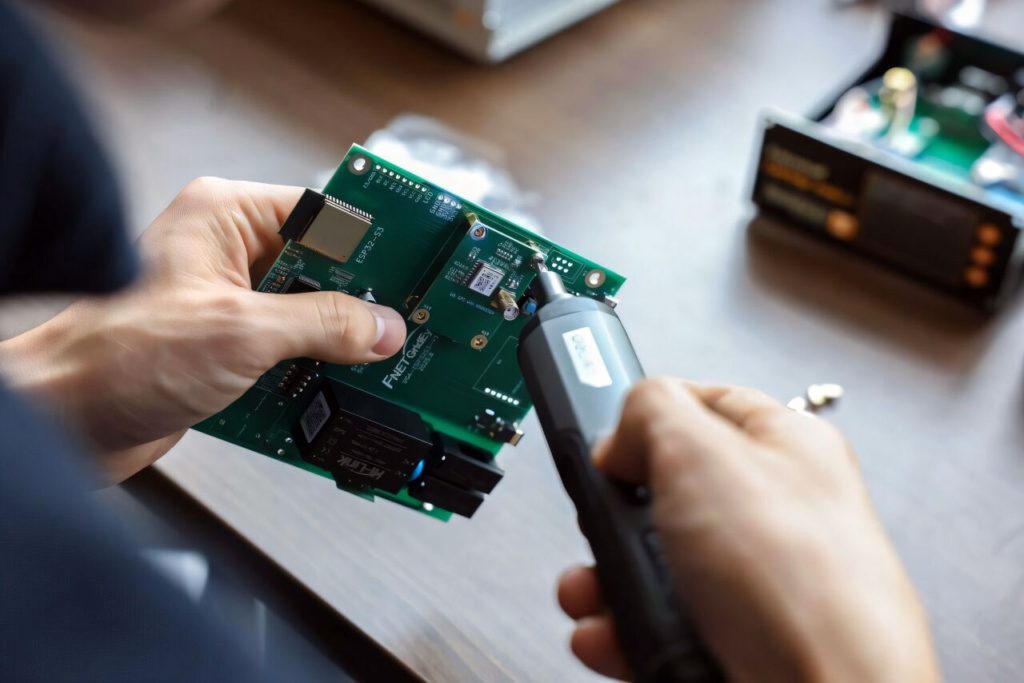
A technician inspects a prototype GridEdge monitoring PCB featuring an ESP32 module.
Why the Universal GridEdge Analyzer matters
As grids absorb more inverter-based generation, battery systems and large “power-electronics” loads (including data centres), operators increasingly care about events that unfold in milliseconds, not minutes. ORNL says the device can process 60,000 measurements per second—claimed to be around 500× faster than the prior approach used by the team—so it can capture transient behaviours that conventional monitoring can miss.
The form factor is also part of the pitch: the analyzer can be embedded into power electronics, or deployed in a simpler “plug-in” style at ordinary outlets. ORNL’s write-up positions it as a practical way to expand situational awareness without turning every measurement point into a major instrumentation project (Oak Ridge National Laboratory write-up).
From wide-area frequency monitoring to waveform detail
The Universal GridEdge Analyzer builds on the long-running FNET/GridEye monitoring platform, which uses GPS-synchronised sensors to provide a broad view of grid conditions. FNET/GridEye has historically focused on system-level frequency/phase-angle visibility, while the new analyzer adds much finer-grained waveform capture to see what individual power-electronic devices are doing at the edge of the network (FNET/GridEye overview).
This kind of edge visibility is becoming relevant well beyond the US, as European grids also push deeper into inverter-dominated operation. For context, eeNews Europe has previously looked at approaches such as grid-forming inverters, which can improve stability but also add new dynamics that are difficult to monitor with slower, aggregated telemetry.
Commercial and deployment signals
The Universal GridEdge Analyzer recently received an R&D 100 Award, which is often used by US national labs as a credibility marker for technology transfer and wider deployment. Whether the device shows up primarily inside OEM power electronics, at industrial sites, or as a utility-led sensor roll-out will likely depend on cost, cybersecurity sign-off, and how well it integrates with existing grid analytics workflows.
 If you enjoyed this article, you will like the following ones: don't miss them by subscribing to :