TouchNetix expands with AX24A touch and force controller
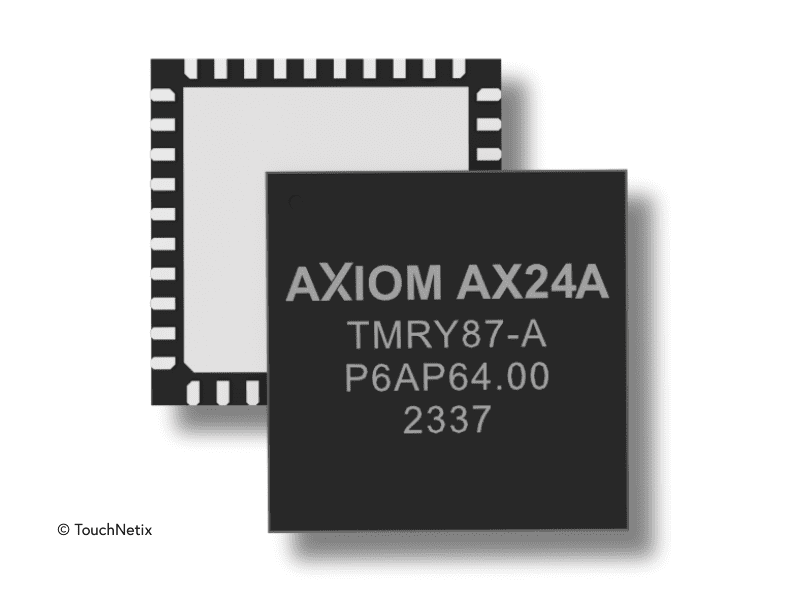
TouchNetix has introduced the AX24A, a touch and force sensing controller aimed at applications that rely on physical buttons rather than touchscreens. The device is positioned for use in industrial, automotive and entertainment systems, particularly where designers are moving towards solid-state interfaces behind conductive surfaces.
For eeNews Europe readers working on HMI design, the announcement is relevant as mechanical buttons continue to be replaced by touch- and force-enabled alternatives, especially in environments where durability, sealing and long-term reliability are key design constraints.
Combining touch and force sensing in a single device
The AX24A extends TouchNetix’s aXiom controller family with support for both capacitive touch and force sensing. According to the company, the device can manage up to 22 touch or force buttons, allowing designers to consolidate multiple inputs within a single controller. The chip is supplied in a 40-pin QFN package, which may suit space-constrained designs.
TouchNetix states that the AX24A is designed to operate behind conductive surfaces, including metal overlays, a requirement that is increasingly common in industrial control panels and automotive interiors. By supporting force-based interaction, the controller is intended to enable button designs that provide tactile feedback without relying on moving parts.
Target applications and design considerations
Potential application areas include automotive interior controls, industrial equipment interfaces and amusement or gaming systems. In these environments, force-sensing buttons can offer advantages in terms of ingress protection and mechanical robustness, while still providing a defined actuation threshold.
The company highlights that the controller’s sensing architecture is intended to support reliable operation across a range of environmental conditions. This could be relevant for European engineers working on systems that must comply with automotive or industrial qualification requirements, where temperature variation and electrical noise are ongoing design challenges.
By integrating touch and force sensing within a single device, the AX24A may also help simplify system design and reduce component count, depending on the application architecture.
 If you enjoyed this article, you will like the following ones: don't miss them by subscribing to :