
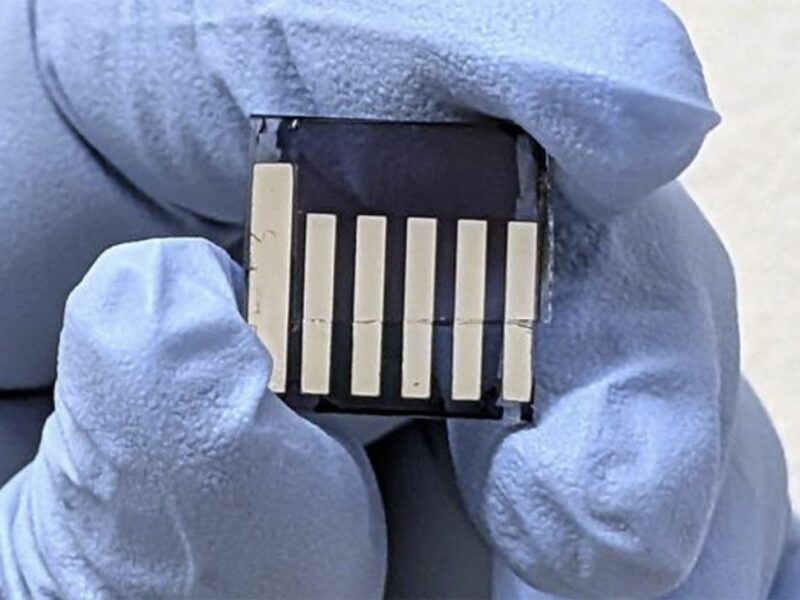
Tiny spectrometer can be integrated into a smartphone
 Cette publication existe aussi en Français
Researchers have successfully demonstrated a spectrometer smaller than a thumbnail, which is orders of magnitude smaller than current technologies and can accurately measure wavelengths of light from ultraviolet to the near-infrared.
The technology enables the creation of handheld spectroscopy devices and holds promise for the development of devices that incorporate an array of new sensors, serving as next-generation imaging spectrometers.
“We’ve created a spectrometer that operates quickly, at low voltage, and that is sensitive to a wide spectrum of light,” says Brendan O’Connor, corresponding author of a paper on the work and a professor of mechanical and aerospace engineering at North Carolina State University. “Our demonstration prototype is only a few square millimetres in size — it could fit on your phone. You could make it as small as a pixel, if you wanted to.”
The technology utilises a tiny photodetector that can sense wavelengths of light after the light interacts with a target material. By applying different voltages to the photodetector, users can manipulate which wavelengths of light the photodetector is most sensitive to.
“If you rapidly apply a range of voltages to the photodetector and measure all of the wavelengths of light being captured at each voltage, you have enough data that a simple computational program can recreate an accurate signature of the light that is passing through or reflecting off of the target material,” O’Connor says. “The range of voltages is less than one volt, and the entire process can take place in less than a millisecond.”
Previous attempts to create miniaturised photodetectors have relied on complex optics, used high voltages, or have not been as sensitive to such a broad range of wavelengths.
In proof-of-concept testing, the researchers found their pixel-sized spectrometer was as accurate as a conventional spectrometer and had sensitivity comparable to commercial photodetection devices.
“In the long term, our goal is to bring spectrometers to the consumer market,” O’Connor says. “The size and energy demand of the technology make it feasible to incorporate into a smartphone, and we think this makes some exciting applications possible. From a research standpoint, this also paves the way for improved access to imaging spectroscopy, microscopic spectroscopy, and other applications that would be useful in the lab.”
The work was done with support from the National Science Foundation under grants 1809753 and 2324190, and from the Office of Naval Research under grant N000142412101.
Image: A series of prototype organic photodetector-based spectrometer cells are shown. Each metal bar is a detector capable of measuring light spectra. Credit: Brendan O’Connor, NC State University.
https://doi.org/10.1016/j.device.2025.100866
 If you enjoyed this article, you will like the following ones: don't miss them by subscribing to :