Structural battery boost for humanoid robot
Figure in the US has doubled the capacity of its battery system and used the casing as part of the structure of its humanoid robot to cut down weight.
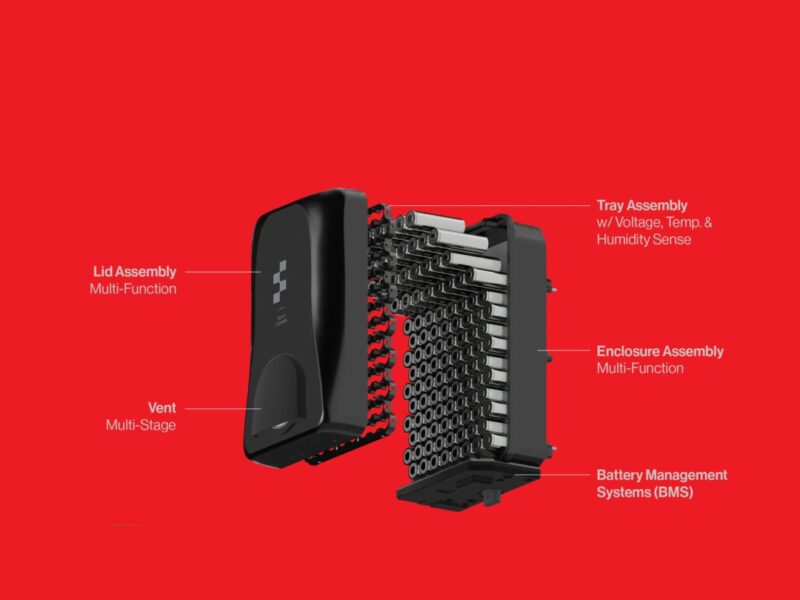
The third generation Figure battery (F.03) has a capacity of 2.3 kWh for five hours of run time at peak performance with 2 kW fast charging with active forced air cooling. A custom Battery Management System (BMS) maintains battery health, optimize performance, and prevent fault conditions
“With battery technology at the heart of our electromechanical humanoid platform, we decided to engineer and manufacture the battery system in-house,” said the company.
The first generation used bulky rectangular modules and components that only fit in an external backpack. F.03 boosts the energy density by 94% and integrates directly into the torso by using high strength stamped steel, die cast aluminium that also acts as a heat pipe, and structural adhesives.
- The march of the humanoid robots
- Open source foundational AI model for humanoid robots
- Humanoid robots speaks 15 languages
“For the F.03 battery, we took on the challenge of dramatically increasing gravimetric and volumetric energy density while raising the bar for safety and reliability. In order to accomplish this, we had to think carefully about every design decision and rapidly analyze, design, test and iterate,” it said.
The F.03 battery integrates multiple functions in nearly every part to increase the cell-to-pack ratio, lower cost, and lower complexity. The custom BMS includes an array of sensors, switches and fuses to prevent fault conditions such as overcharge, overdischarge, over temperature and external short circuit.
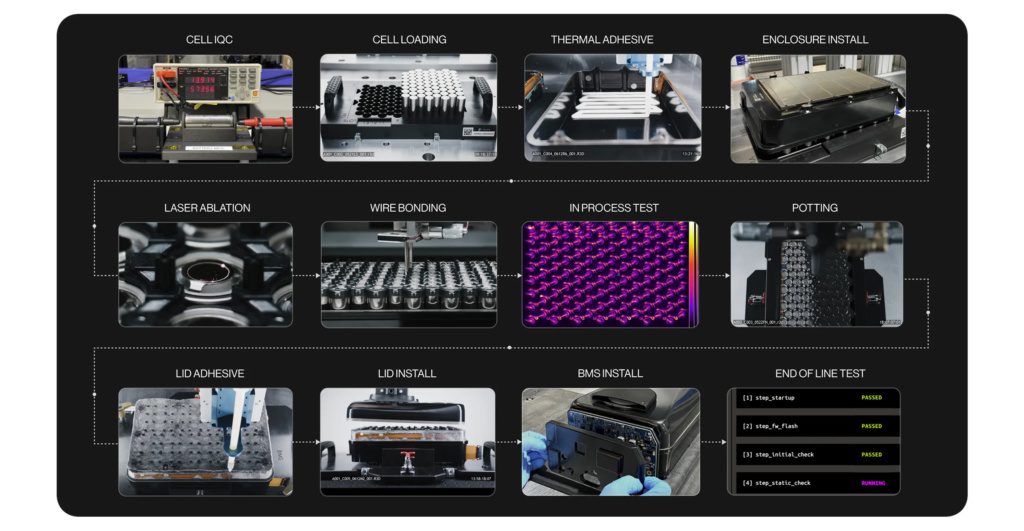
The battery manufacturing process at Figure’s BotQ plant
In the event that one cell goes into thermal runaway from abuse conditions, the pack features a number of safety measures to prevent the thermal runaway from propagating to adjacent cells and to prevent flame from exiting the pack.
Anti-propagation is achieved by using a thermally insulative potting compound in concert with a rapid heat distribution strategy. Flame containment is accomplished with a multi-function flame arrestor pack vent and a patented technology to prevent an external flame from exiting the pack.
The cell-to-cell wirebond interconnect geometry is tuned to act as a fusible element to serve as an additional layer of short circuit protection.
Figure says the F.03 battery is also the first humanoid robot battery in process to be certified to both UN38.3 and UL2271 battery safety standards. Figure worked with a US Nationally Recognized Testing Laboratory (NRTL) to develop an appropriate UL standard for a humanoid robot application with twenty-three primary tests
The F.03 battery was built to support BotQ’s first generation manufacturing line capable of manufacturing up to 12,000 humanoid robots per year.
 If you enjoyed this article, you will like the following ones: don't miss them by subscribing to :