Sodium-sulphur battery turns sulfur into electron donor
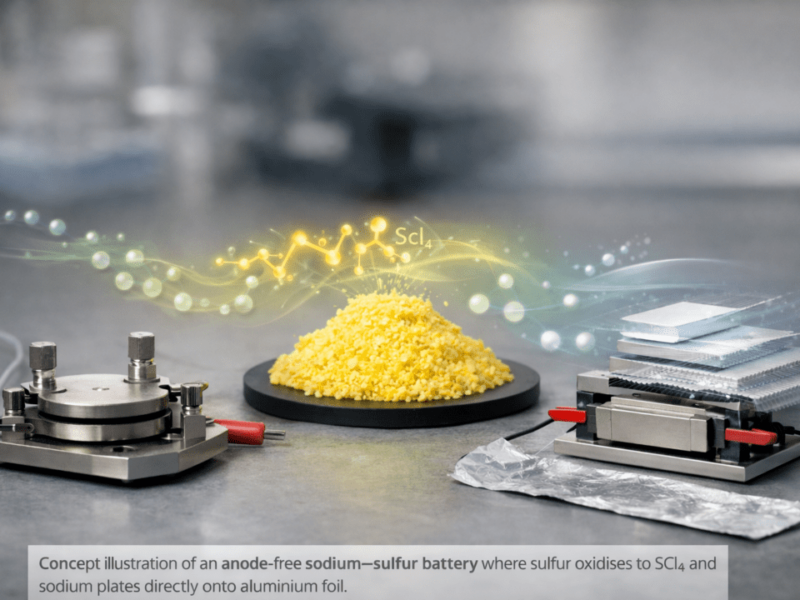
A group of researchers has outlined a room-temperature approach to a high-voltage sodium-sulphur battery that flips the usual “sulphur stores ions” narrative on its head. Instead of treating sulphur mainly as a host for sodium, the proposed cathode chemistry pushes sulphur to higher oxidation states, using chloride from a chloroaluminate electrolyte to form sulphur tetrachloride (S/SCl4 redox). On the other side of the cell, sodium is plated and stripped directly on an aluminium current collector, avoiding a pre-assembled sodium-metal anode.
How the sodium-sulphur battery works
The core idea is an anode-free configuration. During charging, sodium ions in the electrolyte are reduced and deposit as sodium metal on an aluminium foil current collector. During discharge, that sodium is stripped back into the electrolyte. Meanwhile, at the sulphur cathode, sulphur is oxidised through intermediates towards SCl4, with chloride acting as a reactant that enables the high-voltage conversion chemistry. The paper describes this as a 3.6 V-class system, using sodium dicyanamide (NaDCA) to make both the S/SCl4 conversion and Na plating/stripping reversible in a non-flammable chloroaluminate electrolyte.
Why this sodium-sulphur battery result stands out
At the electrode level (counting both cathode and anode), the authors report up to 1,198 Wh/kg and 23,773 W/kg. With an added bismuth-coordinated covalent organic framework catalyst (Bi-COF, 8 wt% loading) in the sulphur cathode, they report up to 1,206 mAh/g (sulphur+catalyst) and a maximum of 2,021 Wh/kg (again on total electrode mass). The work also points to long cycle life in lab testing (with data shown out to 1,400 cycles) and includes a raw-material cost estimate of about US$5.03 per kWh.
As with any battery claim at this stage, the hard part is translating “electrode-level best case” into a packaged cell that survives real duty cycles, is manufacturable, and stays safe and stable at scale. Still, it’s an interesting example of how messy sulfur chemistry can be steered into something useful — and it lands alongside other attempts to make sulfur-based chemistries commercial, as previously reported by eeNews Europe when we looked at Germany’s lithium-sulphur battery programme.
 If you enjoyed this article, you will like the following ones: don't miss them by subscribing to :