Segger revamps for market recovery
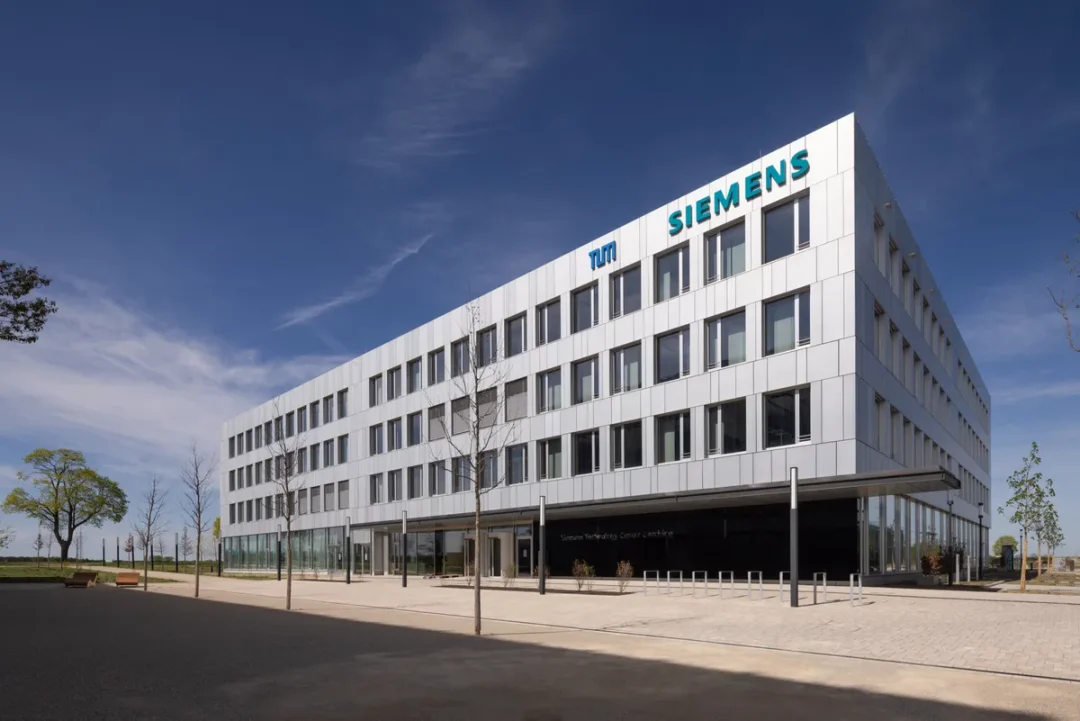
As development tool maker Segger moves into a second building at its German headquarters, Nick Flaherty talks to Dirk Akemann, partnership marketing director about changes to its product line.
Development tools are often one of the first areas to recover after a market downturn, as new projects means engineers need more tools. Segger is restructuring its product lines to prepare for this.
“We are definitely optimistic, whether it’s the bottom of the market its hard to say but the direction is changing and that’s the first step,” Akemann tells eeNews Europe. “The fears of the Ukrainian war getting bigger have reduced with talks about peace in the region and you can see that in discussion with customers and that start to move the market.”
The restructure sees a flow of Create – Build – Debug – Verify – Program. “We have reshuffled a little bit to tie the products to the workflow. This means people understand a lot earlier what we are about and customers know where we are in the process.”
A key difference is breaking out the SystemView verification tool in the Verify step. “Verification is more the system view, event tracing, where you look at the process with SystemView,” said Akemann. “Before it was hidden away and now has its own category with more visibility. We have also added multicore support and the ThreadX real time operating with the complete API. If people want to use it we will support them and we have added people to the team as we are working on expanding it so there’s more to come. We see a lot of potential there.”
“Our view on the Chinese market is that we do have individual customers over there but we talk with the silicon vendors and we are always surprised by how big the market has become with some hidden gems,” he said.
“Some bundle our tools, and all of them are well aware that people using ARM like J-Link and if they want to enter the European market they need that support. “
For example Segger has added support from Zhixin for automotive microcontrollers with ARM Cortex-M0+ and M4 cores as well as hardware acceleration for a European customer. One of their big customers seems to be Continental.
Shipping the development tools such as J-Link also leads to the J-Trace streaming trace tool and the tools to flash the memory, whether in development or in production.
“When we add support for J-Link we immediately have support for the Flasher and J-Trace, Embedded Studio and if the company has a CMSIS-package readily available, embOS support is there as well. So everything is there and that is usually done in a couple of weeks. Most of the time is spend on adapting to the timing of the device or special functions such as locking and memory handling,” he said.
Chip makers such as STMicroelectronics are increasing the memory, with double in the U3 WBA6 for example. This still drives the need for optimisation.
“The U3 WBA6 is already supported with J-trace and we are in close cooperation with ST. When you have more memory to fill sometimes you neglect the optimisation but in the end if you optimise correctly you have room for using simple graphics and intelligent features,” he said.
Rust
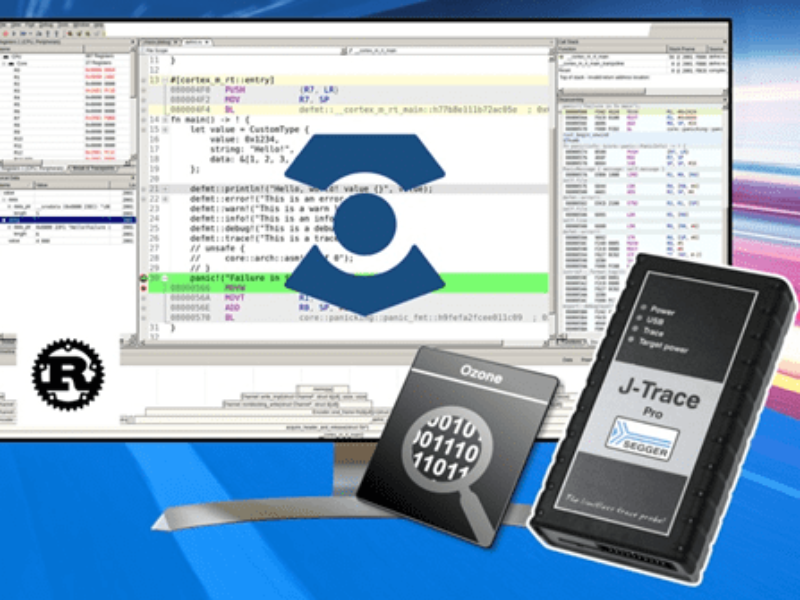
Segger and Ferrous Systems have also shown the combination of the Ozone debugger and J-Trace probes working with a Rust toolchain at the recent Embedded World exhibition.
This ensures that Rust applications compiled with Ferrous Systems’s qualified Ferrocene toolchain can be used with the Ozone debugger and J-Trace streaming Trace probes.
This allow embedded-systems developers to gain detailed insight into firmware operation, down to the instruction level. The tools are compatible with the output of almost any toolchain using Ozone as a debugger and a performance analyzer. It includes all common debugging controls, and it expands on them with features for advanced analysis, such as instruction tracing and code profiling.
Ferrous Systems’s test application is built on RTIC, an open-source, hardware-accelerated, real-time operating system (RTOS) written in Rust. The application also uses the highly efficient deferred-formatting framework “defmt,” produced by Ferrous Systems as part of their open-source Knurling-rs project.
“We’ve always known that defmt offers compelling efficiency improvements when compared to legacy string-based approaches to logging,” says Jonathan Pallant, Senior Embedded Engineer at Ferrous Systems. “We’re delighted to be working with SEGGER to demonstrate this efficiency with Segger’s Ozone debugger and J‑Trace probes.”
www.segger.com; www.ferrous-systems.com
 If you enjoyed this article, you will like the following ones: don't miss them by subscribing to :