Q.ANT raises €62m to scale up photonic processor production
 Cette publication existe aussi en Français
Q.ANT in Germany has raised €62m in the biggest Series A funding for photonic processor technology in Europe.
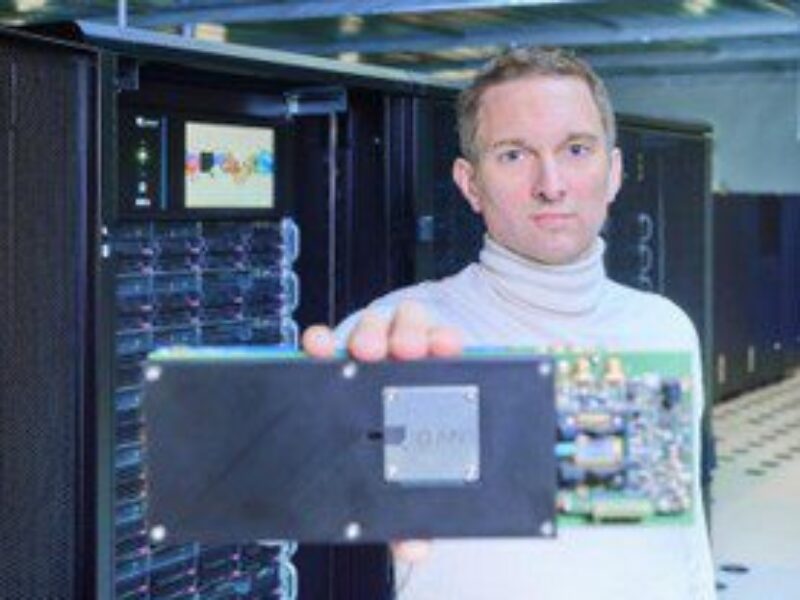
The funding will be used to scale production of its energy-efficient photonic processors for artificial intelligence (AI) and high-performance computing (HPC) and for the development of a 32bit analog optical processor.
The photonic processor was developed at Trumpf and spun off as Q.ANT in 2018 to reduce energy consumption in AI datacentres. This uses thin film lithium niobate for optical processing with a 30x increase in power efficiency to provide a 50x performance improvement without the need for complex cooling systems. It is based on an architecture called Light Empowered Native Arithmetics (LENA) that delivers analog co-processing optimised for complex computation and enabling energy-efficient performance for next-
“We industrialised this in Germany by retrofitting a 1990s-era CMOS line at a fraction of the usual cost, not by building billion-euro fabs,” Dr Michael Förtsch, founder and CEO of Q.ANT tells eeNews Europe.
Photonic processors
“Classical CMOS processors are approaching their physical and architectural limits – where further gains through parallelization and smaller structures yield only marginal improvements. In contrast, photonic computing represents a fundamentally new paradigm with immense, largely untapped scaling potential. Q.ANT has solved the core challenges of this technology and is well positioned to define the future of high-performance computing,” said Cyril Vancura, Partner at imec.xpand.
Arago in Paris and Lightmatter in the US have also been developing photonic processors for the same reason.
“US investment is massive, but most of it goes into scaling old digital architectures—bigger fabs, more servers, and quick fixes for soaring energy use. The industry is hitting its limits: AI datacentres in the US could soon use nearly a fifth of the country’s electricity,” said Förtsch.
“Q.ANT is taking a different approach. We’re not just adding capacity—we’re changing the architecture entirely. Using light instead of electricity, we’ve built a new kind of processor. Moving forward we will make the chip more powerful and integrate it even more conveniently into the computer ecosystem via the software stack.
“We have co-developed a material system that is perfect for photonics and enables precision levels that were previously thought impossible. Our photonic processors use thin-film lithium niobate to achieve high precision and efficiency. That was a bet against the market. We developed a proprietary mixture of TFLN and the bet paid off.”
“Competitors in the international context used a different material and after some time they had to look for other applications because their processors did not work in the quality that the market would accept. They did not reach the precision. Before Q.ANT, 5bit precision was the maximum. Since we have been around, 16bit is no problem. We also have the prospect of 32bit.”
€62m Series A
The round was co-led by Cherry Ventures, UVC Partners and imec.xpand with participation from L-Bank, Verve Ventures, Grazia Equity, EXF Alpha of Venionaire Capital, LEA Partners, Onsight Ventures, and Trumpf.
It has also added Hermann Hauser, founder of ARM and Hermann Eul former member of the Infineon Management Board and former CVP & GM of Intel to its advisory board.
“This investment proves that Europe has both the ambition and the capital to lead – and gives us the strong partners we need to pursue our mission and help shape the future of computing,” said Förtsch.
“Europe has to move beyond policy talk and start building real chip sovereignty: to give preference to technologies from its own ranks, if necessary, install the manufacturing at home, controlling the supply chain, and accelerating adoption (see above). That means backing risk-takers, not just researchers. We need faster, bolder investments and pilots that don’t get stuck in endless planning. At Q.ANT we have achieved a respectable success. But whoever has the first success is not necessarily the winner. We can already see that the USA and China are marching in the same direction. To lead, Europe has to act with urgency and reward those who turn ambition into real deployments.”
Leading technology
“Q.ANT’s photonic chips stand to radically reduce data center operating costs while delivering the breakthrough performance demanded by next-generation AI and high-performance computing,” said Christian Meermann, Founding Partner at Cherry Ventures. “With early commercial momentum and a world-class team of deep tech experts, Q.ANT is uniquely positioned to redefine the trillion-dollar data center semiconductor landscape. We’re proud to back them in building the future of computing.”
“For Q.ANT continue to lead we need investors and partners who understand that simply scaling yesterday’s digital hardware won’t solve the industry’s bottlenecks. With access to long-term capital and industrial customers willing to deploy—and scale—a fundamentally new architecture built around light, not electrons, we know we can make sustainable AI computing a reality in the next five to seven years,” said Förtsch.
“Europe can lead, but only if we move faster and back real innovation—not just scale. This means, we need people to use it, to write code and develop applications on it. So, in order to make the photonic processing technology accessible to software developers, coders and AI developers in the open source community, Europe must have the courage and the will to make it accessible on a broad level. This can give the EU clout back in the industry.”
 If you enjoyed this article, you will like the following ones: don't miss them by subscribing to :