Polymer waveguide boosts CPO co-packaged optics
Researchers in Japan have developed a polymer waveguide with a similar performance to existing approaches for co-packaged optics (CPO) in complex chip packages.
This could reduce the cost of adding optical connections to chip packages to reduce the power consumption while increasing data rates.
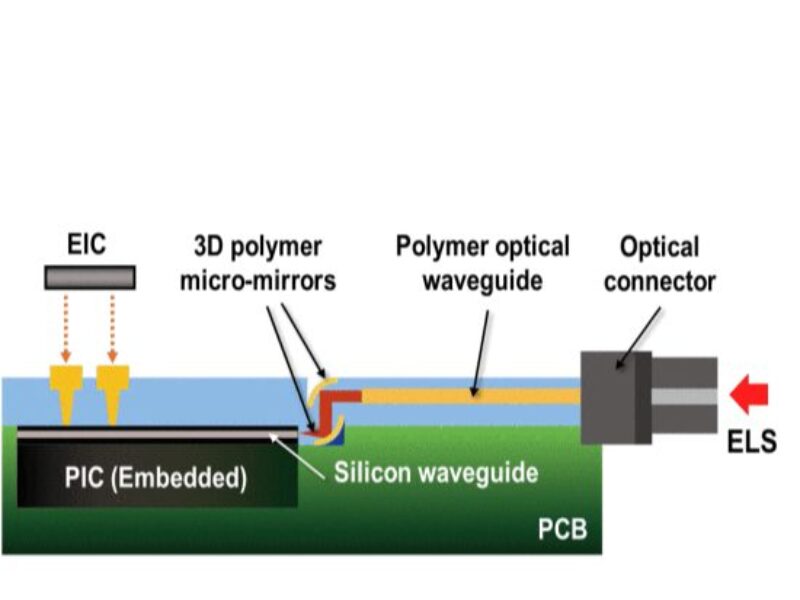
CPO systems require a laser source for operation, which can be either integrated directly into the silicon photonic chips (PICs) or provided externally. While integrated laser sources allow for more connections, ensuring consistent reliability can be challenging, which may affect overall system robustness. Using external laser sources (ELS) in CPO on the other hand can improve the system reliability.
The team of researchers led by Dr. Satoshi Suda from the National Institute of Advanced Industrial Science and Technology in Japan have tested the stability and reliability of single-mode polymer waveguides fabricated on glass-epoxy substrates that can connect directly to single mode optical fibres.
“Polymer waveguides show strong potential for use in demanding CPO systems. We, therefore, evaluated the fundamental optical properties of the single-mode polymer waveguides on glass epoxy substrate,” said Suda.
The team fabricated the 11mm polymer waveguides using direct laser writing on FR4 glass-epoxy substrates. The waveguides had well-controlled core dimensions of 9.0 µm × 7.0 µm, suitable for matching standard single-mode fibres. They had low polarization-dependent loss (PDL) of under 0.5dB and low differential group delay (DGD) of under 0.2ps, along with uniformity across eight fabricated samples. Key parameters such as insertion loss and mode field dimensions demonstrated extremely small variations, ensuring consistent performance across eight waveguides.
Waveguides with low PDL and low DGD can help facilitate stable signal transmission within CPO systems by minimizing distortions. The researchers found that the fabricated waveguides possess consistent insertion loss and mode field dimensions. Low variations in insertion loss and mode field dimensions between waveguides suggest that they can function as energy-efficient optical interconnects, making them suitable for adoption in CPO systems.
In addition, the waveguides fabricated on glass-epoxy substrates exhibited desirable polarization extinction ratio (PER). This is a critical metric that reflects the ability of waveguides to maintain a specific polarization for the signals they transmit. The team measured PER at all wavelengths within the CWDM4 standard, specifically at 1271, 1291, 1311, and 1331 nm and observed a high PER of more than 20 dB across all CWDM4 wavelengths. This meets the specifications for ELS-based CPO systems developed by the Optical Internetworking Forum (OIF).
Testing of glass-epoxy-based waveguides under high power 20dB conditions with external lasers from Furukawa Electric also found that the waveguides were resistant to power degradation even after six hours of continuous use. Thermal analysis showed a minimal temperature rise of approximately 4.4 °C under these conditions, consistent with theoretical predictions.
“These findings demonstrate the strong potential of polymer waveguides for practical deployment in demanding CPO systems, providing a reliable foundation for next-generation high-density and high-capacity optical communication technologies,” said Suda.
 If you enjoyed this article, you will like the following ones: don't miss them by subscribing to :