OQC looks to 50,000 qubit fault tolerant quantum computer
Oxford Quantum Circuits (OQC) in the UK is charting a path to a large scale fault tolerant quantum computer with 50,000 qubits as it looks for a new chief executive and a $100m funding round.
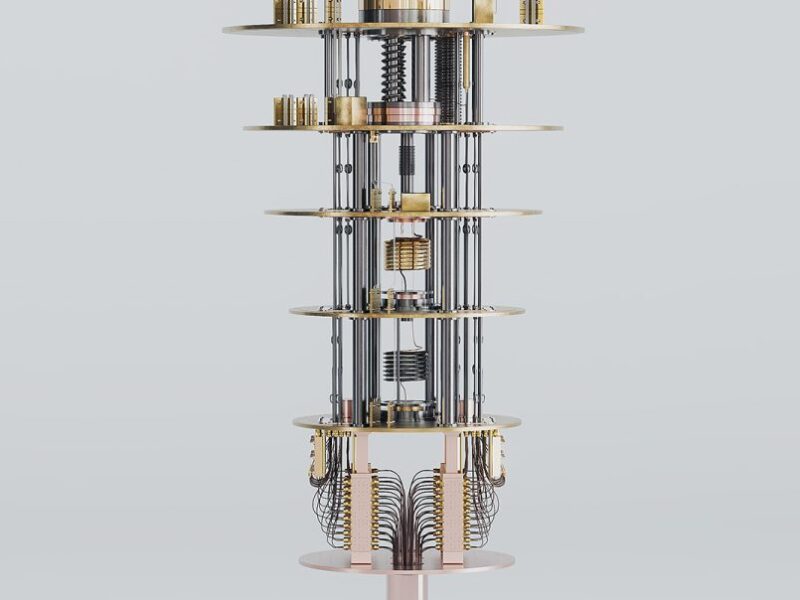
The 50,000 qubit machine would require several million physical qubits, using the dual rail ‘Dimon’ superconducting transmon technology developed by OQC with fault tolerant algorithms from Riverlane.
While the roadmap does not predict this size of system until 2034, this would beat the superconducting qubit technologies from both Google and IBM, says OQM.
IQM in Finland is also pushing into larger fault tolerant machines with superconducting qubits, testing out algorithms on its planned 100qubit system.
- Bringing diamond into the semiconductor supply chain for room temperature quantum computing
- IBM shows 133qubit chip, looks to 1bn gates
OQC uses superconducting transmon circuits developed at the University of Oxford with a 3D design. This allows easier control and readout for scaling into larger arrays with low crosstalk.
Interim OQC CEO Gerald Mullally says it is this approach that puts the company at the front of the global race to build quantum computers with widespread applications, beating supercomputers by 2028 with 200 logical qubits for applications such as fraud detection, arbitrage, cyber threat detection, and vulnerability analysis.
“This roadmap is a landmark for quantum computing, in the UK and globally,” said Mullally, Interim CEO of OQC who replaced founder Ilana Wisby as CEO this time last year. Three months ago Wisby took on the role of CEO at Moth Quantum, a consumer-focused quantum applications company based in London.
“It shows that the moment when quantum computing begins to transform people’s lives is closer than many realise,” said Mullally, who was previously commercial vice president and joined OQC in 2022 from the UK Prime Minister’s Office and Cabinet Office. “This underlines the urgency with which organisations, in particular in financial services and national security, should work out their plan for a quantum-transformed world,” he said.
- OQC in first quantum computer co-location data centre deal
- Rigetti launches 84qubit Ankaa-3 quantum computer
The company raised £38m in 2022 for its Series A round, the largest funding round for a quantum computer firm in the UK. It has been working on its Series B round since 2023, reported to be as large as $100m. This is led by SBI Investment in Japan with existing investors, Oxford Science Enterprises (OSE), University of Tokyo Edge Capital Partners (UTEC), Lansdowne Partners and OTIF. The company also appointed a new chairman o the board, Jack Boyer, in April. Later this year, the company plans to install the first quantum computer in New York City with a data centre partner.
By 2034, the roadmap shows that OQC’s computers will reach 50,000 logical qubits, more than 10 times the highest level reached in published roadmaps for other quantum computing providers. At 50,000 qubits, the applications of quantum computers include decryption, drug discovery, and quantum chemistry. The roadmap also includes an Application Optimised Compute strategy where quantum computing systems are specifically engineered for applications where quantum provides advantage.
This will be achieved by reducing physical error rates of qubits below 0.1% by strategically tuning qubits to reduce errors, in addition to improving the materials for the chips so qubits stay coherent for longer says Simon Phillips, chief technology officer.
The main source of errors in many quantum architectures, including the OQC machines, is when energetic qubit states decay to less energetic ones. The OQC qubit design makes these errors detectable to pinpoint where they happen. This is crucial location information that can significantly reduce error rates, as OQC have recently demonstrated in our work on hardware efficient error-detection
OQC says the “resource ratio” of physical qubits to logical qubits is ten times lower for OQC’s hardware than for today’s state-of-the-art approaches which can take up to 1000 physical qubits for a logical gate.
The OQC qubit gate also achieves 99.8% fidelity in 25ns, making it is among the fastest and most accurate gates ever recorded. This will allow a larger quantum computer to run more complex algorithms.
“It’s great to see a UK champion putting forward such a bold vision for the future of quantum computing,” said Steve Brierley, CEO of Riverlane, which develops fault tolerant algorithms for quantum computers and works with OQC and many other quantum computer system developers.
“As the global race to build useful quantum computers intensifies, OQC’s roadmap is a clear statement of intent and a reminder that the UK can lead on the world stage. Delivering on this vision would mark a breakthrough moment that brings fault-tolerant quantum systems closer to transforming real-world sectors, from financial services to national security,” he said.
 If you enjoyed this article, you will like the following ones: don't miss them by subscribing to :