
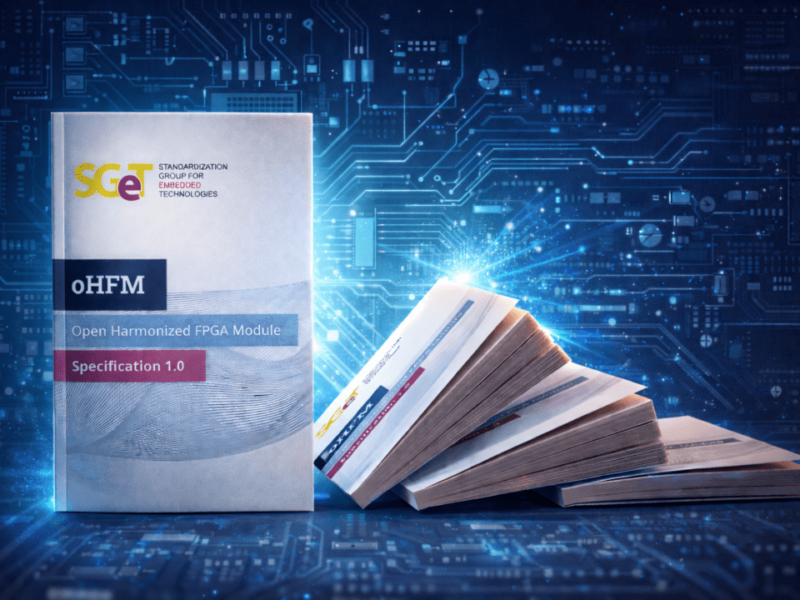
Open Harmonized FPGA Module standard launches as oHFM
SGET (Standardization Group for Embedded Technologies) has published a new, vendor-independent standard for FPGA and SoC-FPGA modules, aiming to make FPGA designs feel more like the computer-on-module world: pick a module, keep the carrier, and scale across performance classes without a redesign. The organisation is calling it the Open Harmonized FPGA Module (oHFM) standard , and it positions the spec as a way to reduce pinout fragmentation and supplier lock-in in embedded FPGA designs.
Open Harmonized FPGA Module standard: what it is
The Open Harmonized FPGA Module standard defines a consistent framework for FPGA modules in two harmonised variants: a connector-based option for higher performance and in-field replaceability, and a solderable option for cost-sensitive volume builds and rugged installations. SGET says the aim is to let developers reuse carrier-board concepts and move between FPGA families and performance tiers more predictably, rather than starting from scratch for each device generation.
-
oHFM.c is the connector-based variant, intended for high I/O density and high-speed interfaces, with multiple scalable module sizes.
-
oHFM.s is the solderable variant, intended for lower profile, mechanical robustness and simpler manufacturing, also offered across scalable sizes.
What the Open Harmonized FPGA Module changes in practice
On the technical side, SGET is pitching oHFM as a “harmonised” set of assumptions around interfaces, power, mechanics and signal break-out, so that module vendors can offer different silicon under a more predictable integration model. The published material highlights a span from entry devices up to SoC-FPGAs with very high-speed serial links (for example, 112 Gbit/s PAM4-class SERDES) and mixed-signal integration such as RF ADC/DAC blocks, which points squarely at edge AI, comms infrastructure and high-end signal-processing use cases.
For readers who have followed SGET’s work on embedded module form factors, this is a logical extension of its “open module” push; as previously reported by eeNews Europe when SGET updated the OSM module specification, the group has been steadily trying to standardise the space between silicon vendors and carrier-board designers.
Availability and ecosystem
SGET says the specification is available as a free download, and that design guides and reference platforms are in progress to support adoption. The spec can be accessed via the oHFM standard page. A republished overview of the announcement also appeared in trade press coverage, for example via Signal Integrity Journal.
 If you enjoyed this article, you will like the following ones: don't miss them by subscribing to :