
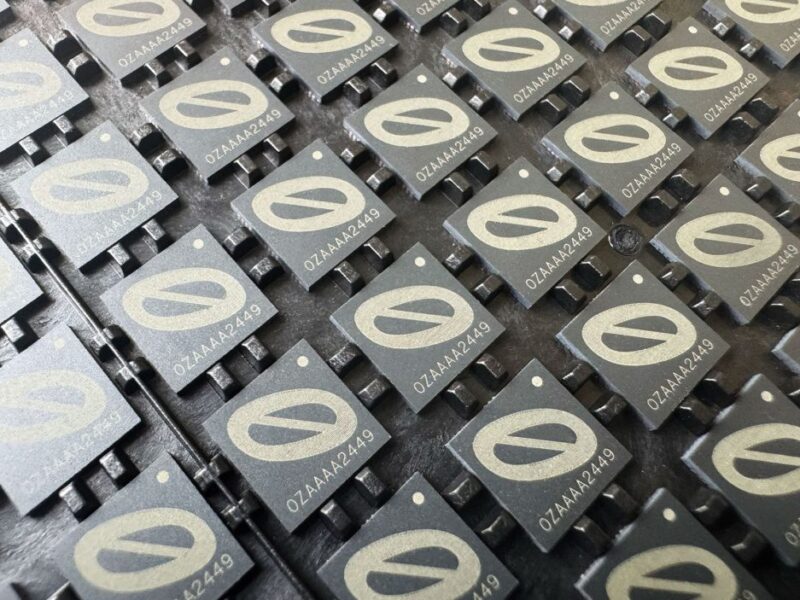
OniO raises €5m to ramp up ultra low power RISC-V microcontroller production
 Cette publication existe aussi en Français
Norwegian chip design OniO has raised €5m to ramp up production of its ultra low power RISC-V microcontroller.
ONiO.zero is the first general-purpose microcontroller that starts from cold from under 1µW, allowing it to run entirely on ambient energy from solar, RF or thermal energy.
The chip integrates a radio, power management, security and memory around a controller core using the open RISC-V instruction set that has been customised for low power operation. Customers have working prototypes and pilot products using the chip in solar keyboards, electronic shelf labels, air quality sensors, asset trackers, and soil sensors monitoring crops.
OniO is working with indoor solar cell maker Epishine in Sweden as well as Exeger and Powerfoyle. There are reference designs for a battery-free remote control and an electronic shelf label. The company has not commented on the process technology other than to say it is using a mainstream process with a standard process development kit (PDK)
The chips show performance of 22µW/MHz and 181 Coremark/mJ on benchmarks from EEMBC, allowing for operation purely from energy harvesting sources but also extending the battery life dramatically for devices in the Internet of Things (IoT).
You can read our interview with the founders of OniO at www.eenewseurope.com/en/onio-looks-to-kill-the-iot-battery-with-risc-v-microcontroller/
The funding round was led by Stockholm-based node.vc, with Helsinki’s Maki.vc as co-lead. Existing investors EIC Fund and MP Pension matched the investment.
“ONiO represents the kind of breakthrough technology we look for at node.vc,” said Mårten Skogö, Partner at node.vc. “Their ability to power a microcontroller entirely from ambient energy is not only technically impressive — it’s fundamentally changing how we think about sustainable IoT. The team has proven that the technology works in real-world applications, and now it’s time to scale.”
 If you enjoyed this article, you will like the following ones: don't miss them by subscribing to :