NVIDIA launches open AI models and simulation tools for robotics
 Cette publication existe aussi en Français
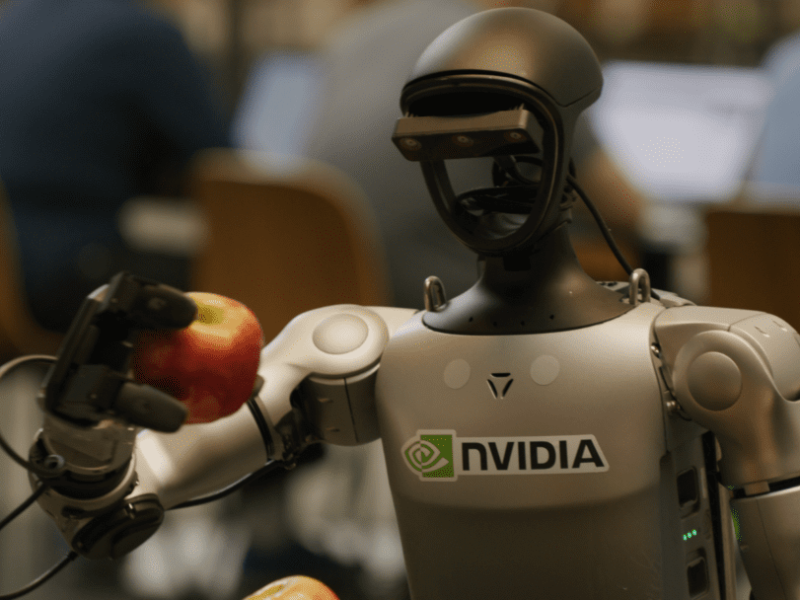
NVIDIA has unveiled a wave of new robotics AI models and open-source simulation tools designed to accelerate humanoid robot research and development. The company is opening up its Newton Physics Engine, Isaac GR00T foundation model, and Cosmos simulation libraries to help developers build more adaptable and intelligent robot AI models.
For eeNews Europe readers, the announcement is significant because it brings together GPU-accelerated simulation, open foundation models, and scalable AI infrastructure — all critical ingredients for the next generation of industrial and service robotics.
Newton engine raises the bar for simulation
Robotics developers rely heavily on simulation to speed training and avoid costly real-world trial and error. With humanoid robots, however, existing physics engines often fall short due to the complexity of joints, balance, and manipulation tasks. NVIDIA’s new Newton Physics Engine, now available in Isaac Lab, promises to change that.
Newton is open-source, GPU-accelerated, and managed by the Linux Foundation. It has been co-developed with Google DeepMind and Disney Research, and is designed to simulate advanced scenarios such as walking on gravel, handling delicate objects, or manipulating tools. Early adopters include ETH Zurich, Technical University of Munich, Peking University, and robotics company Lightwheel.
“Humanoids are the next frontier of physical AI, requiring the ability to reason, adapt, and act safely in an unpredictable world,” said Rev Lebaredian, vice president of Omniverse and simulation technology at NVIDIA. “With these latest updates, developers now have the three computers to bring robots from research into everyday life — with Isaac GR00T serving as the robot’s brains, Newton simulating their body, and NVIDIA Omniverse as their training ground.”
GR00T and Cosmos boost reasoning and data generation
Alongside Newton, NVIDIA introduced Isaac GR00T N1.6, an open robot foundation model that integrates Cosmos Reason — a vision-language-action model for physical AI. Cosmos Reason has already topped Hugging Face’s Physical Reasoning Leaderboard and helps robots interpret vague instructions, turning them into step-by-step action plans with built-in common sense.
Developers can also tap into NVIDIA’s updated Cosmos world foundation models (WFMs), which generate diverse datasets for training AI at scale. The new Cosmos Predict 2.5 supports longer video generation and multi-camera perspectives, while Cosmos Transfer 2.5 can synthesize photorealistic training data from 3D scenes more efficiently.
These tools allow humanoid robots to move with greater freedom and perform more complex tasks, such as opening heavy doors or using two hands simultaneously. Robotics firms including Franka Robotics, Techman Robot, LG Electronics, and Neura Robotics are already evaluating the GR00T models.
Infrastructure for scaling physical AI
To support this new ecosystem, NVIDIA also rolled out infrastructure tailored to robotics workloads. Highlights include:
-
GB200 NVL72, a rack-scale system with 72 Blackwell GPUs, adopted by major cloud providers.
-
RTX PRO Servers, designed for training, simulation, and inference in one unified architecture.
-
Jetson Thor, an edge AI platform enabling multi-AI workflows directly on robots, already being used by Figure AI, Skild AI, and Unitree.
Research community adoption
NVIDIA notes that nearly half of the papers at the latest Conference on Robot Learning (CoRL) referenced its technologies. Universities like Stanford, Carnegie Mellon, and the National University of Singapore are leveraging the company’s GPUs, simulation frameworks, and CUDA libraries to push robotics research further.
With Newton, GR00T, and Cosmos now openly available, NVIDIA is making a clear bid to become the de facto platform for the next era of humanoid and industrial robotics.
 If you enjoyed this article, you will like the following ones: don't miss them by subscribing to :