
3D printing technique developed by TU Delft, MIT
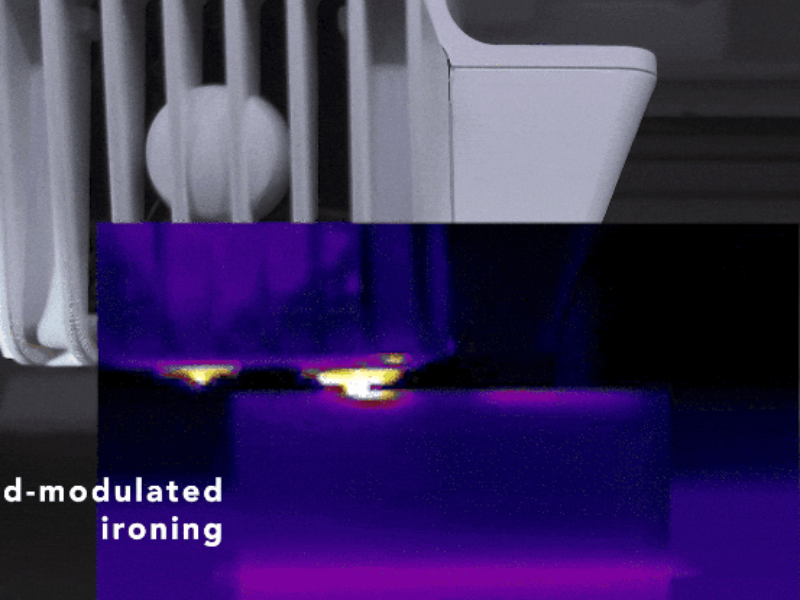
Researchers at Delft University of Technology and MIT have developed a novel 3D printing technique called Speed-Modulated Ironing, enabling high-resolution surface textures and colour gradients using just a single material
Material extrusion 3D printing is being used for an increasingly wide range of applications. A major goal for researchers and makers in this field is to create 3D objects with multiple properties in a single print. Current methods for achieving multi-colour or multi-property prints often involve using multiple materials, limiting the ability to create smooth transitions and fine gradients in the properties of printed objects.
Speed-Modulated Ironing eliminates these limitations by leveraging the temperature responsiveness of filaments like Woodfill, Corkfill, and foaming filaments. This novel approach uses a dual-extruder 3D printer, where one nozzle deposits the material, and a second (empty) nozzle moves over the printed layer, “ironing” it with a constant temperature but at varying speeds. Ironing at lower speeds activates the material more, while ironing faster activates it less. This principle allows to control the resulting properties of the print, such as colour shades, translucency, and tactile textures.
“In attempting to utilise the temperature response, we realised that varying the speed of a nozzle is much more accurate and instant compared to changing its temperature,” says lead researcher Mehmet Ozdemir. “This is the key for our fine-grained control of the applied heat”. However, every material responds in a different way to the ironing. The researchers therefore set up a theoretical model to predict the expected activation of the material. “Our model was essential for understanding the inner workings of Speed-Modulated Ironing and for fine-tuning the process,” says Marwa AlAlawi, PhD student at MIT.
For those who want to explore this technology hands-on, the researchers have developed a design tool that implements the Speed-Modulated Ironing workflow. Users can assign specific visual and tactile properties to 3D models and send the files for printing. The researchers hope that this is just the beginning, as Doga Dogan (MIT) adds: “By making the design tool open source, we aim to enable the 3D printing and maker communities to experiment with this method and develop it further.”
 If you enjoyed this article, you will like the following ones: don't miss them by subscribing to :