Mitsubishi and Nanofiber to develop quantum computer interconnections
Mitsubishi Electric Corporation and Nanofiber Quantum Technologies are launching a project to develop neutral-atom quantum computer interconnection technologies. The project will result in a joint demonstration of the technology.
The project, which aims to conclude at the end of March 2026, will develop core optical quantum interface technologies combining qubit control and nanofibre cavity technologies for neutral-atom quantum computers.
Neutral-atom quantum computers offer significant advantages in scalability thanks to their high integration capabilities and the use of optical tweezers for flexible control of atom arrangement. However, the number of quantum bits (qubits) that can be controlled within a single system is physically constrained by factors such as the space available for arranging atoms. To achieve large-scale quantum computing practically, new technology is necessary to interconnect multiple quantum computers and expand the number of qubits.
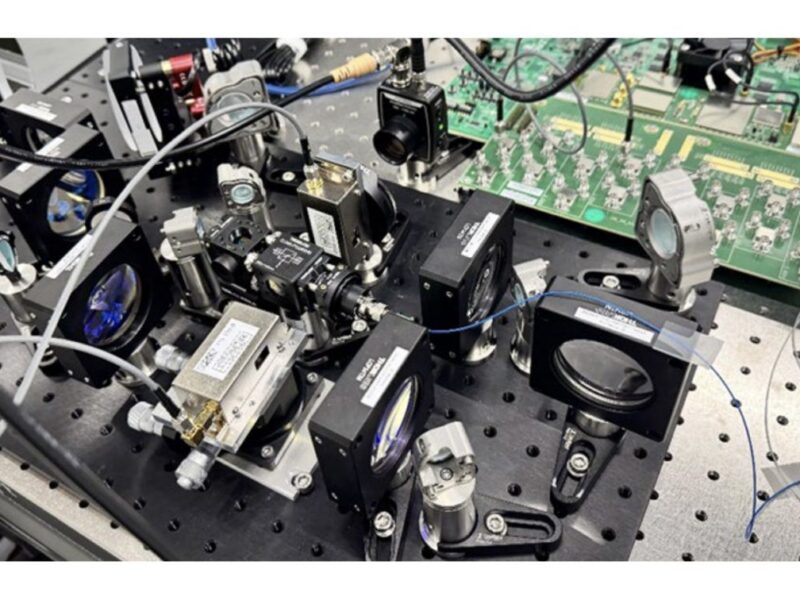
The project will develop a photonic quantum interface by leveraging Mitsubishi Electric’s advanced qubit control technologies and NanoQT’s technology, which combines Yb atoms with nanofibre cavities. It aims to demonstrate technology for highly efficient interconnection between neutral Yb atom quantum computers.
The goal is to create an atom-photon interface that enables highly efficient interconnections between neutral-atom quantum computers. Nanofibre cavities will be used to enhance atom-photon interactions, significantly increasing the efficiency of generating quantum entanglement, which is essential for inter-quantum computer communication. In addition, by storing multiple Yb atoms in nanofibe cavities, the project will parallelise entanglement sharing. Combined with Mitsubishi Electric’s qubit control technologies, these achievements are expected to realise high-speed, large-capacity communication between quantum computers.
Mitsubishi Electric and NanoQT aim to quickly complete a prototype and establish fundamental technologies required for large-scale quantum computing. In the future, they will continue demonstrating optimised quantum-state transfer efficiency to develop robust control technologies through nanofiber cavities. Ultimately, they aim to build a distributed quantum computing platform that addresses real-world industrial challenges.
www.MitsubishiElectric.com
www.nano-qt.com
 If you enjoyed this article, you will like the following ones: don't miss them by subscribing to :