Humanoid robotics market outlook signals shifts for UK industry
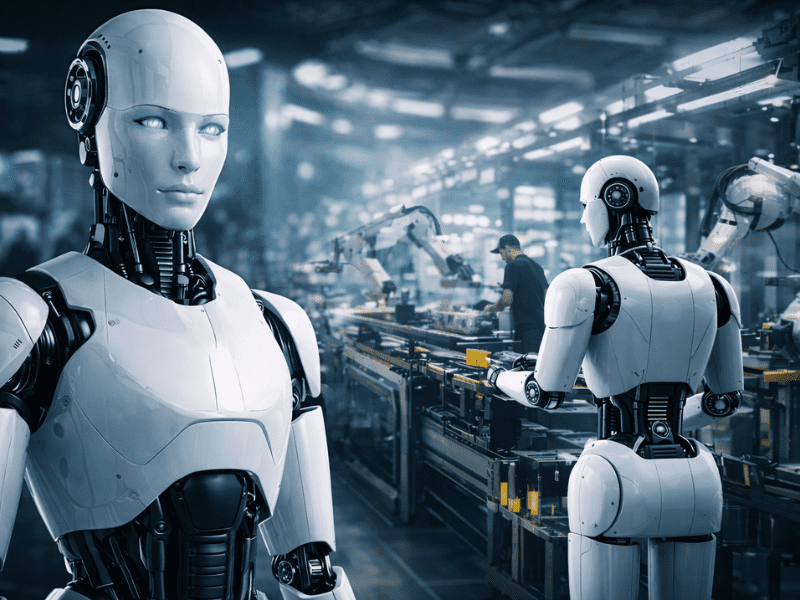
The humanoid robotics market could grow to several trillion dollars over the coming decades. For the UK, this trajectory is increasingly being framed not as a distant vision, but as a set of nearer-term industrial and workforce changes already taking shape.
For eeNews Europe readers, the story is relevant because it connects macro-level market projections with practical implications for manufacturing, automation strategies and skills planning, areas where European engineers and system designers are likely to feel early impact.
Household and industrial use cases move closer
According to analysis referenced by the Royal Bank of Canada, the humanoid robotics market could reach a value of around $9 trillion by 2050, with early demand potentially driven by household applications. These domestic use cases are expected to represent roughly a third of the total addressable market, helping to justify initial volumes and cost reductions.
In parallel, industrial and enterprise adoption is gaining momentum. Research cited from the IEEE’s The Impact of Technology in 2026 study suggests that UK technology leaders increasingly see robotics, extended reality and digital twins as interconnected tools rather than isolated innovations. Respondents pointed to robotics and autonomous systems as areas where AI is likely to have the most visible operational impact in the short term.
Survey data indicates that 40 percent of UK organisations are planning to deploy humanoid robots across parts of their workforce within the next year, while 76 percent believe such systems may quickly move from novelty to everyday presence in working environments. For manufacturing and logistics, this could translate into greater use of humanoid platforms for repetitive or potentially hazardous tasks, complementing rather than replacing human labour.
Skills and design implications for engineers
Beyond deployment numbers, the findings also highlight implications for engineering skills and system design. A majority of respondents expect digital twins and XR tools to become increasingly important in prototyping, process optimisation and workforce training. Around a third identified robotics programming as a key hiring priority for AI-related roles, alongside machine learning expertise.
Commenting on the results, Ayesha Iqbal, IEEE Senior Member and Engineering Trainer at the Advanced Manufacturing Training Centre, said: “The rise of digital twins, XR, and robotics is quietly reshaping how work gets done. What once felt experimental is now part of the day-to-day, from simulating production lines to training new starters in realistic virtual environments.”
She added: “The ability to programme a robot or interpret live data from a digital twin is no longer niche – it has become vital. What’s more, the roles that typically relied on manual experience now involve fluency in systems, modelling, and automation.”
 If you enjoyed this article, you will like the following ones: don't miss them by subscribing to :