

How NTN NB-IoT enables a truly connected world and the role of test
NTN NB-IoT technology enables satellites to provide telecommunication services to Internet of Things devices in areas without terrestrial base station cellular coverage. The technology bridges the digital divide by providing internet and communication services in remote and underserved regions as well as supporting important industries such as precision agriculture, environmental monitoring, global asset tracking, and smart farming through real-time data collection and analysis.
NTN NB-IoT also enhances network resilience by offering backup channels during disasters to help first responders coordinate emergency operations and broadcasts. It facilitates global mobility for aircraft, ships, and autonomous vehicles, provides new business models and revenue streams for mobile network operators, and lays the groundwork for 6G with ubiquitous coverage.
Adnan Khan, Director of Advanced Technology Marketing, explains to eeNews how it works, and the role testing plays in ensuring product conformance.
eeNews: What is NTN NB-IoT, and in what situations does it offer a better alternative to other IoT technologies?
Network operators are extending cellular services that were initially targeted at consumers with smartphones to enterprises with large numbers of Internet of Things (IoT) and Machine Type Communication (MTC) devices. Demand for service continuity is expected to drive the evolution and expansion of networks into non-traditional areas. Non-Terrestrial Networks (NTNs) are becoming a significant focus in research and industry as the world progresses towards 5G-Advanced and, eventually, sixth-generation (6G) systems. The key benefit NTN technology brings is service scalability, continuity and ubiquity, as 7% of world’s population still lacks terrestrial cellular coverage.
Satellite-based communication has the potential to play a crucial role in enhancing communication infrastructure and bridging the digital divide. Typically, a satellite-based architecture utilising Geosynchronous Orbit (GSO), Geostationary Earth Orbit (GEO), Medium Earth Orbit (MEO) and Low Earth Orbit (LEO) systems provides coverage at altitudes ranging from 400 km to 36,000 km. There are, however, trade-offs in performance and deployment costs among the different satellite systems.
NTN is divided into different Radio Access Technology implementations: NR-NTN which is based on 5G New Radio (NR), and IoT-NTN which can be based on Cat-M1 or NB-IoT. Initial deployments are primarily NB-IoT based, offering flexibility of reuse of existing operator assets like spectrum, core network and access network. IoT-NTN can be used to supplement or complement coverage where the cost of deploying a Terrestrial Network (TN) is prohibitive. The sectors that will benefit most from this technology are mission-critical services, utilities, automotive and agriculture.
eeNews: How does NTN NB-IoT fit with developing standards?
The 3GPP (3rd Generation Partnership Project) consortium responsible for developing mobile telecoms standards started work on enabling New Radio (NR) and IoT services through satellites in 2017. Study items on NTNs were included in 3GPP Release-15 and Release-16, and Release-17 has the first set of full 3GPP-compliant IoT-NTN specifications. Releases -18 and Release-19 include work items (WIs) that offer enhancements for IoT-NTN as well as NR-NTN.
Inclusion of NTN in 3GPP standards is significant because it provides device and chipset manufacturers the reassurance they need to incorporate satellite compatibility into their products and also benefit from economies of scale. While some device makers have been supporting GEO satellite services for a long time, this has been on a small scale, limited to specific spectrum bands and proprietary technology, resulting in high costs for customers.
eeNews: What are the significant challenges for NTN devices?
There are several issues that need to be considered when making IoT work over satellites.
Link Budget: The significant distance between user equipment (UE) and base station poses a challenge. The signal must travel downlink (DL) from the satellite gateway on the ground to the satellite in space using the feeder link, and from the satellite payload in space to the UE and vice versa in uplink (UL). This results in a poor link budget, affecting throughput and causing long round-trip times (RTTs). For GEO satellites, the link budget is important, and IoT-NTN offers features such as data repetition in both UL and DL that can help maintain connectivity in areas of marginal coverage and increase demodulation and coverage performance. Reference Signal Received Power (RSRP) could be as low as -140dBm in IoT-NTN, which is not common in terrestrial deployments. Test equipment with advanced RF front-end is required to reliably test this low-signal connectivity.
Latency: RTT delay as high as 500ms for GEO satellites will not be appropriate for delay-sensitive applications. Additionally, there may be times when the base station may reside on satellite payload to minimise the latency and allow more control over mobility. Extended RTT is also problematic for certain control loops in a 3GPP network as it can cause stalling because Hybrid Automatic Repeat Request (HARQ) acknowledgments are not received within the specified window. Additionally, channel feedback from the UE may become unusable by the time it reaches the base station on the ground.
Handovers: Cells in NTNs are very large, as well as fast moving from the perspective of LEO. Designing the network to limit the overhead signalling as well as trigger handover is challenging, not only based on signal strength but also based on location of user in the cell.
Interference: Feeder links from the gateway on the ground to satellite, and service links from satellite to user can be using spectrum that may be owned by mobile network operator or satellite constellation operators. It’s important that the spectrum is carefully monitored to proactively avoid any interference between TN and NTN deployments.
Doppler shift: For satellites in non-geostationary orbit, rapid movement relative to the Earth is an added complication. A LEO satellite at an altitude of 600 km, for instance, travels at approximately 7.5 km/s and will orbit the Earth in 90 minutes. This leads to Doppler frequency shifts that can be as large as 24 ppm.
Time drift: As a satellite moves towards or away from the user equipment, the reference time between the UE and the gNB base station shifts. This presents challenges for synchronisation and initial time advance. Additionally, neighbour measurements become more difficult as the timing of the serving cell and neighbour cell may diverge when they are on different satellites.
eeNews: What part are test platforms playing in the growth of NTN IoT-NB?
Testing can be divided into three aspects: field test, satellite test and UE test.
For field test, it’s important to properly design, integrate and deploy a terrestrial network in the field. Special care has to be taken when carrying out spectrum deployment and performing coexistence testing between terrestrial, non-terrestrial networks and incumbent services utilising the spectrum. Anritsu’s remote spectrum monitoring tools or handheld spectrum analysers (MS2090A) are useful for this purpose. For latency tests to check throughput, latency and packet loss tests, Anritsu’s MT1000A network performance tester provides a straightforward way of testing different satellite configurations.
The LEO satellites that will be deployed in huge numbers will be equipped with antennas that need to be characterised using a combination of vector network analysers, signal generators and analysers. Additionally, some of the deployment may include regenerative architecture, which is a base station on the satellite. There could be different configuration of base station deployment depending on combinations of distributed components. There could be a Distributed Unit (DU) and a Radio Unit (RU) on the satellite and a Centralised Unit (CU) on the ground; gNB function RU/DU/CU all in the sky; or RU/DU/CU/Part-of-Core-Network all in the sky. There may also be a need to test the capacity of base station components in addition to performance testing of these different combinations. A UE simulator and BTS SA/SG are important tools for this aspect of testing.
UE testing can be broken into Over the Air (OTA) testing, Radio Frequency (RF) Conformance testing, Protocol Conformance Testing (PCT), RF/Protocol R&D level testing, and Carrier Conformance Testing.
eeNews: What data does a conformance test collect and analyse?
Conformance tests are created to align with 3GPP requirements or carrier requirements. Figure 1 shows an example of a Protocol Conformance Test (PCT) system set up to test user equipment (UE) against protocol specifications defined in 3GPP, like 36.521.
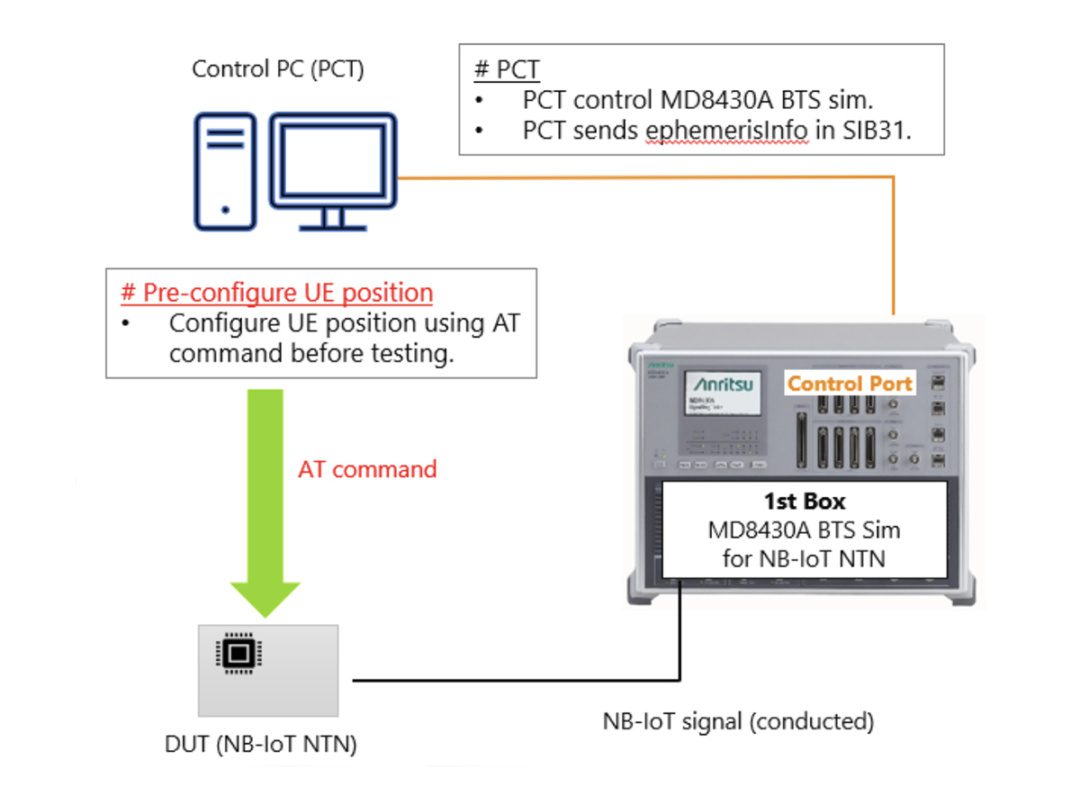
Figure 1: Example of a PCT system for IoT-NTN, testing a UE against protocol specifications defined in 3GPP
The protocol conformance suite consists of testing different areas of protocol stack that has been introduced from NB-IoT to NB-IoT NTN. Almost all layers of the protocol stack have been impacted by introduction of IoT-NTN. These test procedures are standardized in 3GPP document 36.521. Testing areas include HARQ processes, new System Information Block (SIB) parameters, positioning reporting, timers and handovers.
eeNews: How does this sort of testing help engineers evaluate devices in conditions they’ll encounter in the real world?
It is important to thoroughly test devices against network simulators that have properly implemented the network protocols, parameters and conditions before the devices are commercialsed. Often, a terrestrial or non-terrestrial network may not exist to test the devices as the features/technology have not been enabled, or it may not be possible to control the live network to generate corner cases or adverse scenarios. It’s key to simulate a realistic radio environment for satellite and ground base stations and test devices accordingly; dealing with issues that are only identified after a device has been commercially launched can be cost prohibitive.
eeNews: What is the process for a conformance test to be adopted?
Adoption of a conformance test for test equipment involves several steps, ensuring that the equipment meets industry standards and performs reliably. Here’s an outline of the typical process:
A typical process starts by understanding relevant standards and requirements. Test specifications and procedures include 36.521-4 (TRx measurements), 36.521-3 (Performance/RRM measurements) and 36.523 (Protocol measurements).
A comprehensive set of test cases then needs to be developed, based on the conformance requirements, that cover all necessary protocol/RF functionalities and scenarios. Test cases have to be detailed, specifying the expected outcomes and criteria for passing or failing each one.
Test cases can then be implemented in test equipment, ensuring each can be executed with automation. Logging and reporting functionalities are incorporated to capture detailed results of each execution.
Accuracy and reliability of the implemented test cases is established through internal testing in partnership with a chipset vendor. Once sufficient confidence has been developed, a test case can be submitted to an accredited certification laboratory for evaluation. The lab will assess the equipment’s compliance with the relevant standards and protocols against different bands as needed for Global Certification Forum (GCF) or PCS Type Certification Review Board (PTCRB) by testing under different bands and with multiple devices. GCF and PTCRB have their own criteria on mandating device OEMs to include the respective tests as part of the test enablement.
The process described here is equally applicable to carrier conformance tests, except the tests are usually executed for validation in operator facility for validation and certification.
Once certified test equipment has been deployed to customers or test labs there will of course be a need for ongoing technical support, updates and maintenance to address issues that emerge or changes in specifications.
eeNews: What is Anritsu doing to encourage innovation in this area?
IoT-NTN is an evolving technology and as new features are introduced in future 3GPP releases it’s important to have access to the devices to that have enabled the early feature drops. Partnership with variety of chipset vendors is also important as not all features will be available on all chipsets at the same time.
Anritsu has worked with leading chipset and OEM device vendors like Sony Altair, Mediatek, Qualcomm and Samsung to collaborate on verifying conformance tests as soon as key features are stabilised before submitting protocol/RF conformance test results to accredited labs. Anritsu has also partnered with Satellite Network Operators (SNO) like Skylo to validate their test requirements on Anritsu platforms.
www.anritsu.com/en-us/test-measurement/solutions/non-terrestrial-networks-test
 Adnan Khan, Director of Advanced Technology Marketing, CTO Office, Anritsu Company brings over 20 years of expertise in the wireless industry, having worked with operators, chipset vendors, network infrastructure providers, consumer electronics and handset manufacturers, as well as test equipment companies. Throughout his career, he has held senior technical and management roles and is currently a key member of the CTO Office at Anritsu, where he drives the strategic technology roadmap for Anritsu’s portfolio of wireless and wireline products. Adnan earned his Bachelor of Science in Electrical Engineering from the University of Texas at Austin and resides in Texas.
Further reading
Low-cost sub-GHz long-range connectivity to drive IoT markets
CNES and UNIVITY team up on French space-based 5G
First Open RAN broadband NTN LEO satellite constellation
 If you enjoyed this article, you will like the following ones: don't miss them by subscribing to :