
First spin photon receiver for AI data links
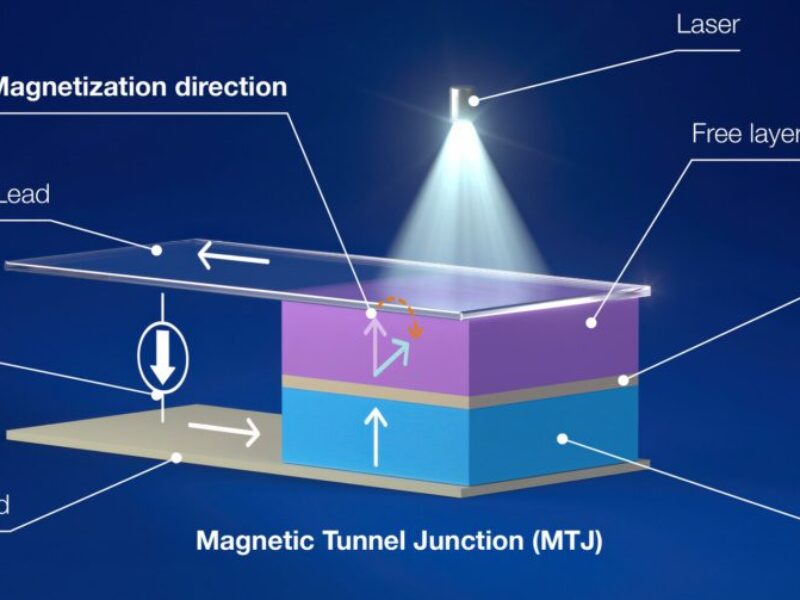
TDK has developed a photo-spintronic conversion element that combines optical, electronic, and magnetic elements for faster AI data transfer.
The spin photon detector responds in 20 picoseconds with 800nm light, more than ten times faster than conventional semiconductor-based photo detectors. This is a key driver for higher speed photoelectric conversion in data transmission and processing in AI while reducing power consumption.
TDK adapted its CoFeB magnetic tunnel junction (MTJ) technology, which is currently used in billions of HDD heads, for photonics. One of the major advantages of this technology is that it does not require crystal growth using a single crystal substrate, and the device can be formed regardless of the substrate material so it can be bult on any type or board or substrate. This will be key for integration into AI accelerator chips and chiplets for co-packaged optics (CPO).
- Nvidia looks to silicon photonics to cut datacentre power
- 3D photonic chip delivers record 116Tbit/s speed
Because the Spin Photo Detector has a completely different operating principle and uses an electron heating phenomenon, it can operate at ultra-high speeds even when the wavelength is shortened to 800nm. It also supports a wider operating wavelength range than silicon converters, operating from visible light to near-infrared light in tests with Nihon University in Japan.
The detector can also be used in AR/VR smart glasses and high-speed image sensors as well as aerospace applications as it has a strong resistance to cosmic rays.
 If you enjoyed this article, you will like the following ones: don't miss them by subscribing to :