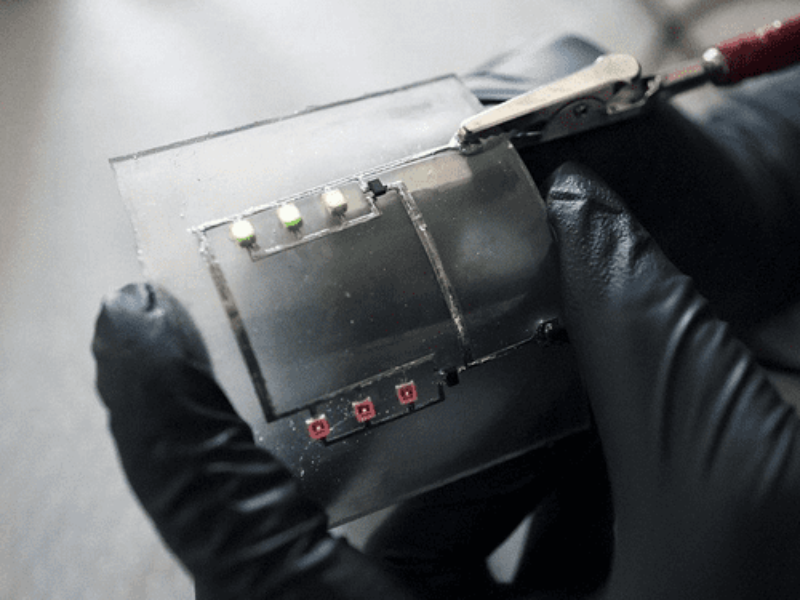
Electronic circuits from dynamic composite material can be healed or reshaped
The new circuits are recyclable, electrically conductive, reconfigurable, and self-healing after damage
Michael Bartlett, associate professor of mechanical engineering, and Josh Worch, assistant professor of chemistry, both from Virginia Tech, come from different fields, but together they created a new class of circuit materials.
“Our material is unlike conventional electronic composites,” said Bartlett. “The circuit boards are remarkably resilient and functional. Even under mechanical deformation or damage, they still work.”
The new material starts with a vitrimer, a dynamic polymer that can be reshaped and recycled. This versatile material is combined with droplets of liquid metal that do the work of carrying the electric current, the way rigid metals do in a traditional circuit.
This is a fundamentally different approach from other recyclable or flexible electronics. By combining the high-performance, adaptable polymers with electrically conductive liquid metals, the new circuit holds up under a host of challenges.
“Traditional circuit boards are made from permanent thermosets that are incredibly difficult to recycle,” said Worch. “Here, our dynamic composite material can be healed or reshaped if damaged by applying heat, and the electrical performance will not suffer. Modern circuit boards simply cannot do this.”
The vitrimer circuit boards also can be deconstructed at their end of life using alkaline hydrolysis, enabling recovery of key components such as the liquid metal and LEDs. Fully reusing all components of the conductive composites in a closed-loop process remains a goal for future research.
Find the full article here
 If you enjoyed this article, you will like the following ones: don't miss them by subscribing to :