
DRAM memory without the capacitor shows promise
A new DRAM bit cell without a capacitor and with two thin-film transistors shows promises for continuing the DRAM technology roadmap
An imec report:
The bit cell of dynamic random-access memory (DRAM), the main memory within traditional compute architectures, is conceptually very simple. It consists of one capacitor (1C) and one silicon (Si)-based transistor (1T). While the capacitor’s role is to store a charge, the transistor is used to access the capacitor, either to read how much charge is stored or to store a new charge.
Over the years, bit cell density scaling allowed the industry to introduce subsequent generations of DRAM technology and cope with the growing demand for DRAM. But since about 2015, DRAM memory technology has struggled to keep pace with the performance improvement of the processor’s logic part: scaling, cost, and power efficiency issues form the building blocks of a rising ‘memory wall’. The large capacitor constrains scalability and 3D integration of the 1T1C bit cell, the ultimate path towards high-density DRAM. In addition, as the access transistor gets smaller, it provides an increasingly large leakage path for the capacitor’s charge to drain away. This lowers the data retention time and requires DRAM cells to be refreshed more frequently – impacting the power consumption.
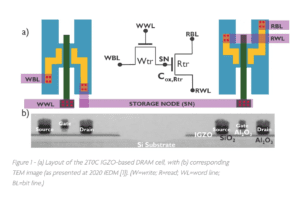
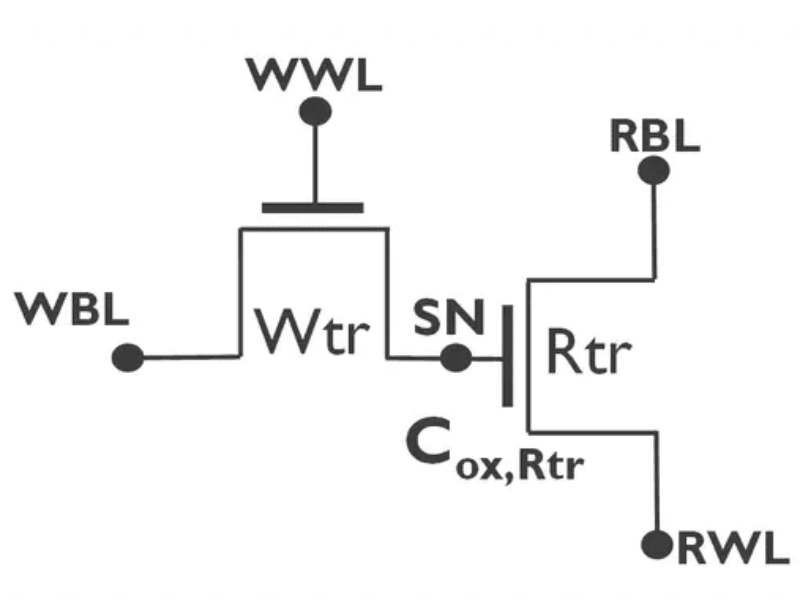
In 2020, imec reported a novel DRAM bit cell concept that can solve these two issues in one go: a bit cell made up of two thin-film transistors (2T, one for read, one for write) and no capacitor (0C) [1]. The conduction channel of the thin-film transistors is composed of an oxide semiconductor, such as indium-gallium-zinc-oxide (IGZO). Due to its wide bandgap, IGZO-based transistors have an extremely low off current, benefitting the memory’s retention time, refresh rate, and power consumption. The longer retention time also relaxes the requirement for the storage capacitance, allowing the parasitic capacitance of the read transistor to take over the role of the storage element … read more
 If you enjoyed this article, you will like the following ones: don't miss them by subscribing to :