ConcreteSC Breakthrough Promises Leap in Wireless Semantic Communications
Researchers at SeoulTech have unveiled ConcreteSC, a digital semantic communication framework that could accelerate the adoption of next-generation wireless systems. The technology, published in IEEE Wireless Communications Letters, shows up to threefold improvements in image quality and 39× faster processing speeds compared with conventional approaches.
The work addresses a critical challenge in digital semantic communication — efficiently transmitting meaning instead of raw data. For eeNews Europe readers, this research highlights a key enabler for future 6G networks, smart factories, and large-scale AI-driven IoT ecosystems, where data throughput and low-latency performance are paramount.
A New Approach to Semantic Communication
Semantic communication has emerged as a disruptive shift in wireless systems, emphasizing meaning over exact data replication. For instance, when transmitting an image, the system prioritizes the semantic content rather than pixel-perfect accuracy. This allows for higher efficiency and a more task-oriented communication process, which is crucial as connected devices and AI workloads scale.
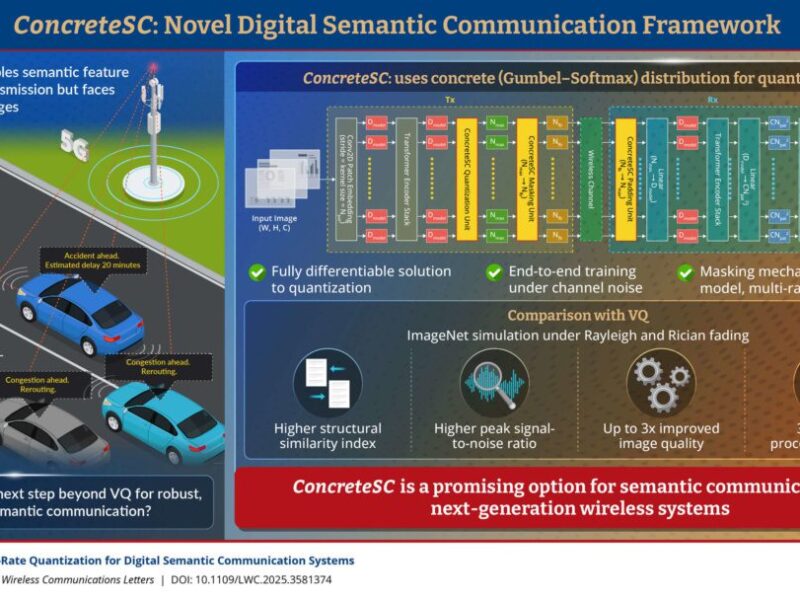
However, most current digital semantic systems rely on vector quantization (VQ), a method that demands large codebooks and often struggles with noise and training divergence. To overcome these limitations, Dr. Dong Jin Ji, Associate Professor at Seoul National University of Science and Technology, and his team introduced ConcreteSC. The method eliminates codebooks by employing temperature-controlled concrete distributions, enabling a more flexible and efficient digitization mechanism.
“Unlike vector quantization (VQ)—a state-of-the-art digitization technique that suffers from channel noise and codebook divergence during training—our framework offers a fully differentiable solution to quantization, allowing end-to-end training even under channel noise. Notably, because ConcreteSC directly generates the required bitstream, it is possible to train a multi-feedback-length model pair with a relatively simple masking scheme,” explained Dr. Ji.
Performance and Applications
In simulations using the ImageNet dataset under Rayleigh and Rician fading conditions, ConcreteSC consistently outperformed VQ-based methods in terms of structural similarity index and peak signal-to-noise ratio. The research shows that ConcreteSC not only improves quantization quality but also reduces computational complexity, as its operations scale linearly with bit length rather than exponentially with codebook size.
This scalability makes the framework particularly well-suited for integration into broader semantic communication architectures. It holds promise for 6G networks, where ultra-dense machine-type communications in smart factories and advanced IoT environments will require robust, low-latency, and high-efficiency solutions.
“Sixth-generation wireless communication systems, where semantic communication technologies are expected to be one of the key enablers, are expected to be a major area of application for our technology. These include smart factories, where ultra-dense machine-type communications are prevalent,” Dr. Ji noted.
Looking Ahead to 6G and Beyond
The implications of ConcreteSC extend far beyond academic research. The technology could play a central role in enabling fully autonomous factory systems that eliminate the need for extensive cabling, embedding AI directly into equipment. It also has potential in healthcare and lifestyle monitoring applications, where low-power IoT devices must reliably transmit data from seniors, toddlers, or patients while supporting large-scale AI models.
With 6G development accelerating worldwide, semantic communication frameworks like ConcreteSC may become foundational to ensuring that next-generation networks can handle the growing demands of intelligent, interconnected systems.
 If you enjoyed this article, you will like the following ones: don't miss them by subscribing to :