AI tool automates end-to-end machine learning
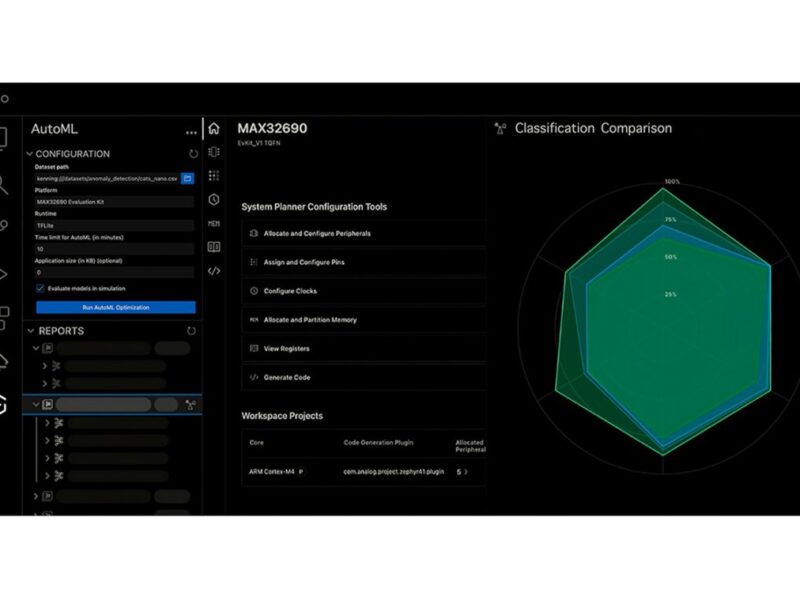
Analog Devices Inc. (ADI) has introduced AutoML for Embedded, a tool that makes edge AI accessible, efficient, and scalable by automating the end-to-end machine learning pipeline.
The AI tool was co-developed with Antmicro and is now available as part of the Kenning framework, integrated into CodeFusion Studio. The Kenning framework is a hardware-agnostic and open-source platform for optimising, benchmarking, and deploying AI models on edge devices.
Automating the end-to-end machine learning pipeline allows developers without data science expertise to build high-quality and efficient models that deliver robust performance. In a recent demonstration, AutoML for Embedded was used to create an anomaly detection model for sensory time series data on the ADI MAX32690 MCU. The AI model was deployed both on physical hardware and its digital twin in Renode simulation, showcasing seamless integration and real-time performance monitoring.
As AI rapidly moves to the edge and demand for intelligent edge devices surges, developers struggle to fit powerful models onto tiny microcontrollers. Developers face a steep learning curve as they juggle data preprocessing, model selection, hyperparameter tuning, and hardware-specific optimisations. Recognising this need, ADI co-developed AutoML for Embedded to enable developers to build and deploy robust, resource-intensive machine learning models on edge devices, such as microcontrollers and other constrained platforms, without wrestling with complex code or hardware constraints.
AutoML for Embedded is a Visual Studio Code plugin built on the Kenning library that supports:
- ADI MAX78002 AI accelerator MCUs and MAX32690 devices — deploy models directly to industry-leading edge AI hardware.
- Simulation and RTOS workflows — leverage Renode-based simulation and Zephyr RTOS for rapid prototyping and testing.
- General-purpose, open-source tools — allowing flexible model optimisation without platform lock-in.
AutoML for Embedded automates model search and optimisation using state-of-the-art algorithms. It leverages SMAC (Sequential Model-based Algorithm Configuration) to explore model architectures and training parameters efficiently, and applies Hyperband with Successive Halving to focus resources on the most promising models. It also verifies the model size against the device’s RAM to enable successful deployment.
Candidate models can then be optimised, evaluated and benchmarked using Kenning’s standard flows, with detailed reports on size, speed and accuracy to guide deployment decisions.
“Building on the flexibility of our open-source AI benchmarking and deployment framework, Kenning, we were able to develop an automated flow and VS code plugin that vastly reduces the complexity of building optimised edge AI models,” said Michael Gielda, VP Business Development at Antmicro. “Enabling workflows based on proven open-source solutions is the backbone of our end-to-end development services that help customers take full control of their product. With flexible simulation using Renode and seamless integration with the highly configurable and standardised Zepher RTOS, the road to transparent and efficient edge AI development using AutoML in Kenning is open.”
www.analog.com
https://antmicro.com
 If you enjoyed this article, you will like the following ones: don't miss them by subscribing to :