US House moves to extend AI chip export controls to the cloud
The US House of Representatives has passed a bipartisan bill intended to close what lawmakers see as a “cloud loophole” in technology controls: foreign adversaries gaining remote access to export-controlled American AI hardware by renting capacity in offshore data centres.{index=0}
Why AI chip export controls are moving to the cloud
The proposed Remote Access Security Act (H.R. 2683) would broaden how US export controls can apply when a “foreign person” accesses controlled items remotely via a network connection, including a cloud computing service, from outside the location where the hardware is physically installed. The bill passed the House on 12 January 2026 by 369–22.
Supporters argue the shift matters because advanced GPU capacity can effectively be “exported” without shipping a single accelerator card: a customer can rent time on controlled chips hosted in a third country and use them over the network. The House Select Committee on China said the measure modernises the Export Control Reform Act by making clear that export controls can apply to “remote access” and “cloud-based exposure” of controlled items.
What the AI chip export controls bill would change
In practical terms, the legislation would put “remote access” on a similar footing to existing export-control concepts, giving the US Department of Commerce’s Bureau of Industry and Security (BIS) clearer authority to require licences and enforce penalties when controlled technology is accessed remotely.
That would sit alongside BIS’s existing export-control framework for advanced computing items and related activities, including policy guidance that has addressed how certain AI-development activities can intersect with Export Administration Regulations (EAR) controls.
What’s driving it: reported offshore GPU rentals
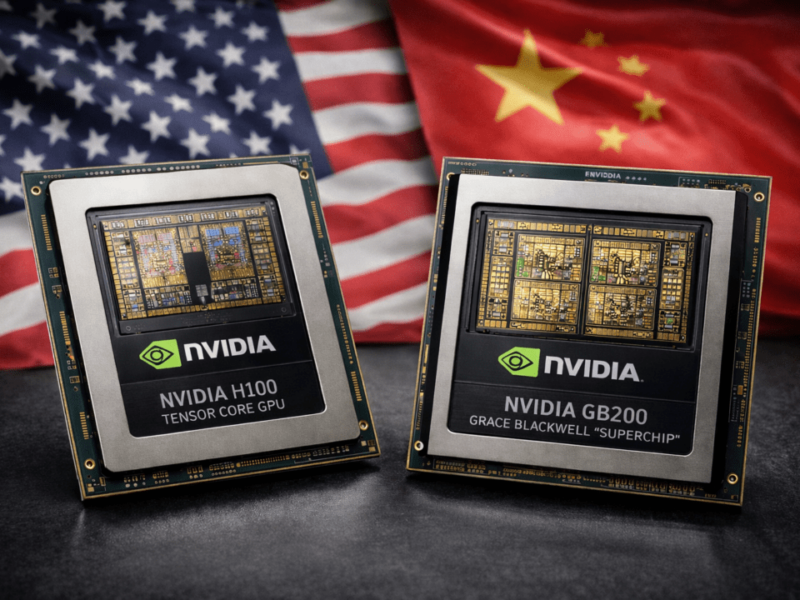
The House move follows a run of reporting and political attention on Chinese firms accessing leading-edge Nvidia GPU capacity outside China. One widely cited example involved Shanghai-based startup INF Tech and a deal route involving Indonesia, built around racks containing Nvidia GB200 systems (Blackwell) at an estimated value of about US$100 million.
For broader context on where US policy has been heading, eeNews Europe has previously tracked the ongoing tightening of controls across the semiconductor stack, including measures affecting advanced manufacturing and memory. As previously reported by eeNews Europe when the US tightened export controls on lithography, etch and HBM memory, enforcement and scope have been moving targets as Washington tries to limit capability transfer while industry pushes back on over-broad restrictions.
What happens next
The Remote Access Security Act must still clear the Senate and be signed into law to take effect. If it advances, cloud providers and “GPU rental” intermediaries may face stronger compliance obligations around customer screening, licence requirements, and how remote access is provisioned for controlled accelerators and systems.
 If you enjoyed this article, you will like the following ones: don't miss them by subscribing to :