ABB and NVIDIA bring physical AI simulation to factory robots
Industrial robotics is taking a major step toward more realistic AI-driven development as ABB Robotics partners with NVIDIA to integrate NVIDIA Omniverse libraries into its widely used RobotStudio engineering platform. The move aims to dramatically improve simulation accuracy and accelerate the deployment of AI-powered automation on factory floors.
The new capability, called RobotStudio HyperReality, is expected to launch in the second half of 2026 and is already being tested by manufacturers including Foxconn and the robotics automation startup Workr.
For eeNews Europe readers working in robotics, industrial automation and AI systems, the announcement highlights a significant shift toward simulation-driven engineering and synthetic data pipelines that could reshape how factories design and deploy robot systems.
Physical AI simulation moves closer to reality
The integration of NVIDIA Omniverse libraries directly into ABB’s RobotStudio platform brings high-fidelity, physics-based simulation to more than 60,000 robotics engineers who already use the software. The goal is to close the long-standing “sim-to-real” gap — where robots trained or programmed in virtual environments behave differently when deployed in real-world factories.
“Combining RobotStudio with the physically accurate simulation power of NVIDIA Omniverse libraries, we have closed technology’s long-standing ‘sim-to-real’ gap – a huge milestone to deploying physical AI with industrial-grade precision, for real-world customer applications,” said Marc Segura, president of ABB Robotics.
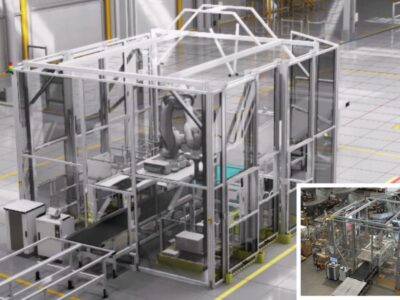
In the new workflow, engineers can export a fully parameterized robot station—including robots, sensors, lighting and kinematics — as a USD file into NVIDIA Omniverse. ABB’s virtual controller then runs the same firmware used by the physical robot, enabling simulation results that reportedly correlate with real-world behavior at up to 99% accuracy.
The platform also enables synthetic data generation for AI training. Images created in the simulated environment can be fed directly into machine vision models, allowing engineers to train AI systems without large real-world datasets.
According to ABB, the combination of photorealistic physics simulation, synthetic data and its Absolute Accuracy technology — which reduces robot positioning errors from around 8–15 mm to roughly 0.5 mm — can deliver a new level of precision for industrial applications.
Faster deployment and lower engineering costs
Beyond accuracy improvements, the companies say the technology could significantly reduce engineering effort and deployment costs. ABB estimates the new workflow could cut engineering time, reduce deployment costs by up to 40% and accelerate time to market by as much as 50%.
Manufacturers can design and validate entire automation cells virtually before deploying hardware, potentially cutting setup and commissioning times by up to 80% while eliminating the need for many physical prototypes.
Early adopters are already testing the system. Foxconn is piloting the technology in consumer electronics assembly, where small metal components and rapid product changes often complicate automation. Meanwhile, Workr is integrating its WorkrCore platform with ABB robots trained using synthetic data generated through Omniverse.
ABB is also exploring integration of NVIDIA’s Jetson edge AI platform into its OmniCore robot controller to enable real-time AI inference across its robot portfolio — hinting at a future where industrial robots can be trained virtually and deployed rapidly with minimal manual programming.
 If you enjoyed this article, you will like the following ones: don't miss them by subscribing to :