3000% Capacitance improvement for Super Capacitor
 Cette publication existe aussi en Français
Researchers have developed an ultramicro supercapacitor that surpasses current models in storage and compactness. Its design incorporates Field Effect Transistors and layers of molybdenum disulfide and graphene
Researchers at the Department of Instrumentation and Applied Physics (IAP), Indian Institute of Science (IISc), have designed a novel ultramicro supercapacitor, a tiny device capable of storing an enormous amount of electric charge. It is also much smaller and more compact than existing supercapacitors and can potentially be used in many devices ranging from streetlights to consumer electronics, electric cars, and medical devices.
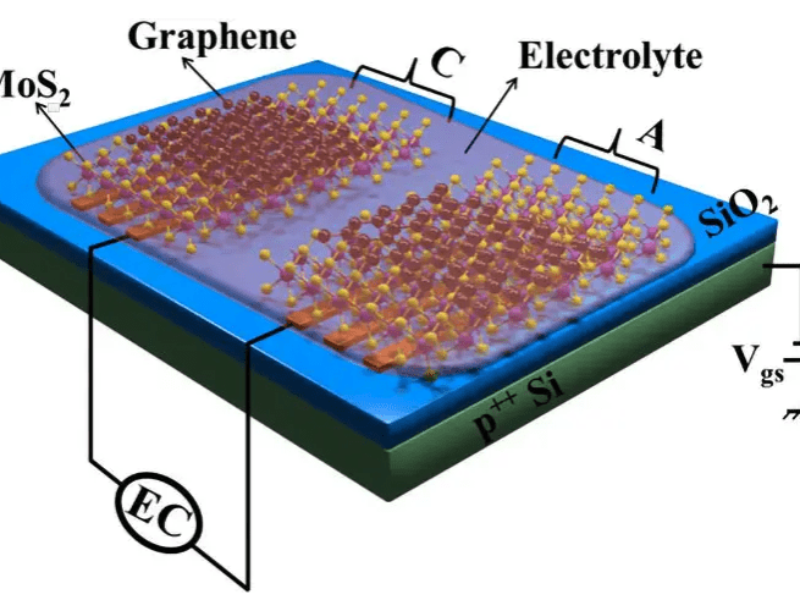
In the recent study, published in ACS Energy Letters, the researchers fabricated their supercapacitor using Field Effect Transistors or FETs as the charge collectors, instead of the metallic electrodes that are used in existing capacitors. “Using FET as an electrode for supercapacitors is something new for tuning charge in a capacitor,” says Abha Misra, Professor at IAP and corresponding author of the study.
Current capacitors typically use metal oxide-based electrodes, but they are limited by poor electron mobility. Therefore, Misra and her team decided to build hybrid FETs consisting of alternating few-atoms-thick layers of molybdenum disulfide (MoS2) and graphene – to increase electron mobility – which are then connected to gold contacts. A solid gel electrolyte is used between the two FET electrodes to build a solid-state supercapacitor. The entire structure is built on a silicon dioxide/silicon base.
“The design is the critical part, because you are integrating two systems,” says Misra. The two systems are the two FET electrodes and the gel electrolyte, an ionic medium, which have different charge capacities. Vinod Panwar, PhD student at IAP and one of the lead authors, adds that it was challenging to fabricate the device to get all the ideal characteristics of the transistor right. Since these supercapacitors are very small, they cannot be seen without a microscope, and the fabrication process requires high precision and hand-eye coordination.
or visit https://iisc.ac.in
 If you enjoyed this article, you will like the following ones: don't miss them by subscribing to :